Two Steps Forward, Two Steps Back

This is my latest circular yoke. What you can’t see if that I ripped back a couple inches, knit it again, ripped it back, and knit it once more. It’s been that kind of week.

I was trying, for a couple of days, to figure out how to get a bit more width on the Front of my circular yoke (for two obvious reasons) and still arrive at the needed number of stitches at the bottom of the yoke. If you also need this, good news, I was successful in the end. I figured out how to work 12 more stitches across the Front, above the bust and the divide, with 12 fewer stitches across the Back. This suits me and maybe it suits you too.

I’m hoping to post the pattern next week, all things going better than they did this week!

I now have 3 projects working the helical method. I thought I would just show you how the yarn you use affects how it looks.

This is the 3 colours, one-round stripes, in 3 solid colours.

Again, 3 colours, 2 solids and one variegated with a long colour change (cinnamon to light blue).

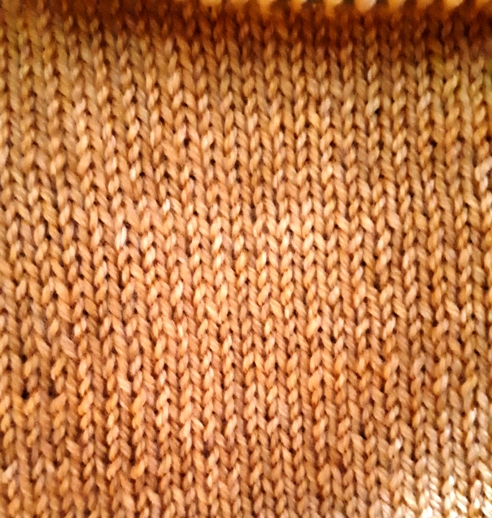
This is my stash bust of 2 variegated and one solid (brown).

All three using the same technique with very different results. Is this amazing or what?!

To continue my forward/back week, I started the Lunenburg circular yoke. It’s way more complex than mine. It is a Bohus style colour yoke with purl stitches which are part of this style. I am, at the moment, curious about all things circular.

I find picking colours really difficult so choosing 4 contrast colours against the main colour, grey, was not smooth sailing. I started with this.

I decided that I wasn’t feeling the pinkness. Ripped this back too.

Also, this pattern has lots of colours you use for only one round which means lots and lots of ends. So I decided I could take it down to 3 colours and the main colour. One of my colours goes from light grey to yellow (unfortunately you can’t see that in the photo) so I’m substituting it for the two light colours in the chart. Fewer ends, hoorah. I’m really happy with my decision.

I’m using Briggs and Little Sport in medium grey, teal blue, grey heather and Softspun Lite ‘n Fancy in the grey/yellow (the colour I’m using as both the 2 light colours in the pattern). After several inches of knitting the yoke, I finally feel like I am relaxing into the colour knitting. It’s been a while since I did any.

We are in the middle of the southern ontario snow dump. I live in a basement apartment and my view is filling up with the white stuff.

I’m burrowed in knitting. How about you?

Deb

Any Gauge and Gauge-Free patterns by Deb

deb.gemmell on instagram

debgemmell435 on youtube

Have a Merry Time

It’s that time of year. I hope you are enjoying some holiday cheer. Best wishes to you and yours.

I have knitting plans, of course, for the holiday. Plans to finish a few things.

This hat, a Two Triangle Hat made out of chunky weight left-overs.

Today I am going to block this sweater. There, it’s in writing, now I have to do it. Wait, I’ll just go run water into the sink … there that’s done, now it’s going to happen. It’s one of those double stranded mohair + wool sweaters and I’m a little nervous about washing and blocking. Have you done this? Did it work out ok?

Another sweater that I started waaay back has sleeves to finish. I am knitting them 2 at a time, my new favourite way. Of course you wouldn’t know that since it’s been sitting for a while but I am looking forward to doing the sleeves.

Then there is the Christmas sock gift that I have to finish pretty smartly. These I’m knitting in the helical way with 3 colours. I am enjoying watching the colours come together.

Phew, after all of that, I might, just might, start a pullover for my grandson. I have the yarn on my desk and it is calling to me.

In January I am going to knit another vest. I have an idea, which may or may not work, but that’s the fun of it.

See you on the other side. Happy New Year, 2024, yikes!

Deb

Any Gauge and Gauge-Free patterns by Deb

deb.gemmell on instagram

Raglan, No Pooling

Here we go. I’ve taken apart a sweater I don’t wear, reconditioned the wool and now I’m going to get started on a new pullover. I hope to avoid colour pooling this time.

I’m working my Any Gauge Raglan Pullover pattern with a gauge of 5 sts = 1″. This wool has a lot of colour variation in every ball so … I’m going to knit it with 5 balls at the same time!!!

Yes, 5 balls, count ’em.

OK, OK, I didn’t start with 5. I started with one. I cast on all the stitches for the raglan neck opening with ball#1, placing markers as I went.

Then I got 3 more balls out and, working the raglan increases according to the pattern, I knit the Back with ball#1, knit the first shoulder with ball#2, knit the Front with ball#3, knit the second shoulder with ball#4. That takes me back to the beginning of the round. Each section of my raglan is knit with a different ball of wool and my first set of increases have been worked.

Here is where the Helix knitting (in this case, changing the yarn in the same place each time) comes into play. With one more ball, ball#5, I knit the Back to the marker, dropped that wool and slipped the marker. With the next ball, the wool that is sitting right there, I knit across the shoulder to the next marker. Dropped that wool and slipped the marker. Knit across the Front using the wool from the next ball that is sitting there. Slipped the marker and again with the wool that is sitting there, knit the second shoulder to the end of the round.

I know this sounds complicated but the wool you need to use is right there at each marker. You drop the wool you are knitting with, slip the marker and pick up the new wool and knit.

There is, of course, a TRICK. Do Not Twist the wool at each marker. When you approach a marker, take the wool strand you were just using and hold it to the right, slip the marker and pick up the new strand of wool from underneath. It’s not twisted.

Why bother with all this?

Two reasons. Because you don’t twist the wool when changing balls, there is no pull at the raglan lines where the markers are. It’s a smooth transition. Reason Two: THE BALLS DO NOT TANGLE.

How is this possible?

When you knit you are moving the yarn from the left needle to the right needle so the circle of knitting is moving clockwise. That twists the wool like this.

Every couple of rounds, grab your circle of knitting like a steering wheel and turn it counter-clockwise, like you’re making a left turn.

This really works!! I’m a little further along now. This is how the colour is coming out on my knit shoulder. An even distribution of uneven colour.

I’m pretty happy.

Cheers, Deb

Any Gauge and Gauge-Free patterns by Deb

Deb on instagram

Rescue: Rip and Reuse

I’m antsy and can’t settle, so it’s obviously time to demolish something. I’m frogging (rip, rip, ripping) a sweater that I don’t wear even though I love the colour. Let’s call it rescuing the wool. I want an orange sweater, just not this one.

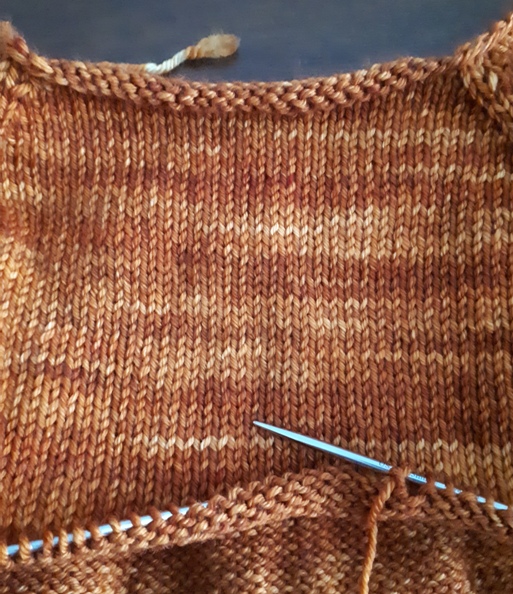
I can’t stand the colour pooling. I worked this as a gradient between the different balls of yarn, working a couple stripes with the old ball and the new ball. But that didn’t really work, did it? The pooling is not good, especially across the chest. So here I go.

It’s actually strangely satisfying.

Now that I have Helical Knitting down pat, I’m going to use this technique to mix up the balls of yarn throughout. It has to work better than what I had.

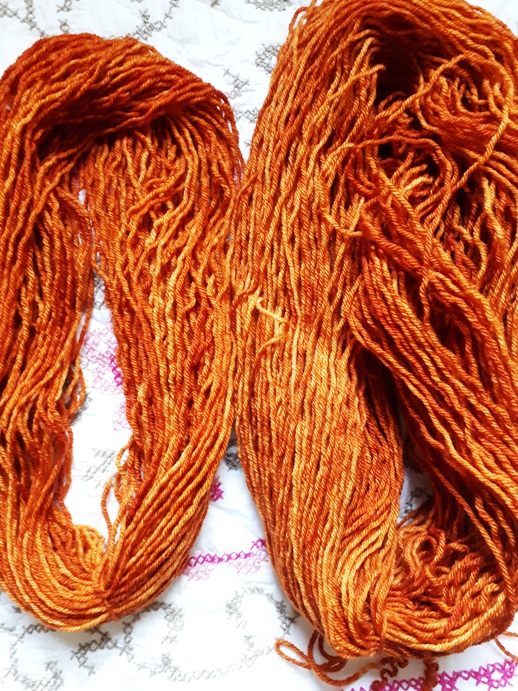
I don’t know whether to use 3 balls or four. It’s so hard to tell which balls match each other. The colour saturation is different in each skein. I think these first two balls are similar with more light colour.

I think these last two balls might be slightly more uniform in colour but … I’m not too sure.

So I’m thinking 3 balls at a time should do it. One of the balls is smaller which is great. I don’t want to switch out 3 balls for 3 different balls. It might cause a line across the sweater, so having to sub in a new ball when this small one is used up will be a good move.

I’m off to cast on. I hope this works.

Are you working on any challenges lately?

Deb

Any Gauge and Gauge-Free patterns by Deb

Deb on instagram

Helical knitting to the rescue

Sometimes, a technique that is used for one application can be used somewhere else to solve a different problem. It might be nothing the original technique was ever set up for. That is the case with Helical Knitting.

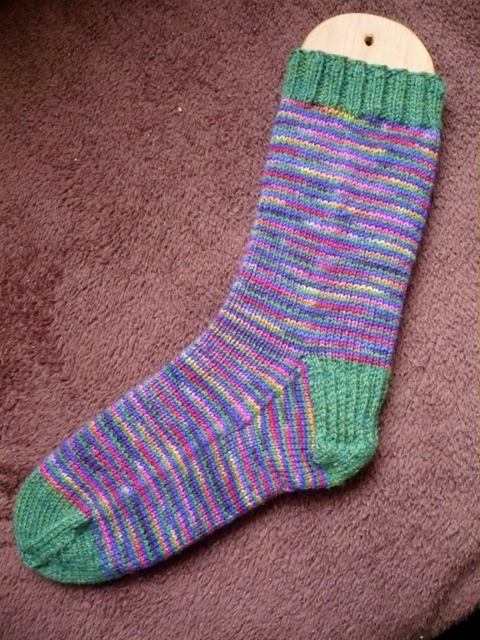
Helical Knitting is working coloured stripes in the round without a jog at the beginning of the round. In this sock, one stripe was a solid colour and one stripe was variegated.

If you haven’t heard of this or haven’t given it a try, this video is from the book Something New to Learn about Helical Knitting:

Basic 1×1 Helical Stripe video by Jen and Jim of Arnall-Culliford Knitwear.

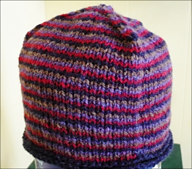
Once you have mastered 1×1 stripes you can work 3 or more coloured stripes: Multi-round Helical Knitting. This hat has 4 colours.

All that’s great but where is the alternative application? Right here.

I am knitting with kettle dyed yarn. The general rule for knitting with yarn that’s not commercially dyed is to work with two balls of wool, alternating rounds. I am always afraid there might still be some pooling so I used 3 skeins and the Multi-Round Helical Knitting method.

I set it up for 3 stripes. I’m calling them stripes even though all the stripes are the same colour. It seems silly but it ties into the Helical technique video above. It means I have 3 balls coming from my project and yes, they do tangle but … I have very smooth colour with some colour variation but no pooling.

I will certainly be doing this again. This might be a terrific technique for you too.

Keep on, keeping on. Cheers, Deb

Gauge-Free and Any Gauge patterns by Deb

Deb on instagram