Where to Widen Raglan Lines

So I took a chance and decided to Add A Pattern to the Raglan Lines. It looks amazing. The pattern on the raglan lines are perfect. I’m at the bottom of the yoke. After this row it’s really going to look like a sweater and I’m excited. Then it happens, as I put my sleeve stitches on spare yarn I realize my lovely raglan line pattern is half on the sleeve and half on the body and not what I intended. My raglan line pattern is ruined!

Yes, it’s happened to me too. The first time it’s hard to envision the entire process. A little time thinking ahead would have saved me some grief.

Don’t get surprised when you do the Great Divide (separating the Sleeves and Body). Look ahead to the bottom of the Yoke. Where do you want the pattern you’ve added to the raglan lines to end up? Maybe you do want half of it on the Body and half of it on the sleeve. Or do you want the pattern to continue down the sides of the Body?

That’s what I decided to do this time. I wanted to widen the raglan lines so that when I reached the bottom of the yoke and put my sleeve stitches on spare yarn, I would have the raglan patterned stitches on the Fronts and Back.

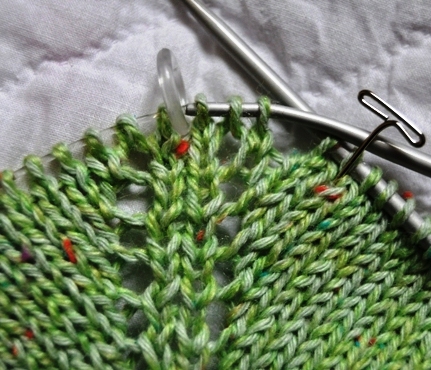
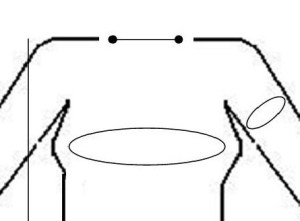
To do this, at the top of the yoke arrange the raglan lines placing a new raglan marker the number of stitches for the pattern away from the stitches for the sleeve, towards the Front and Back of the yoke.

move raglan lines

The dark lines are where the original Raglan Markers are. Then place a second marker at each raglan line towards the Front and Back, in this case moved over by 5 stitches.

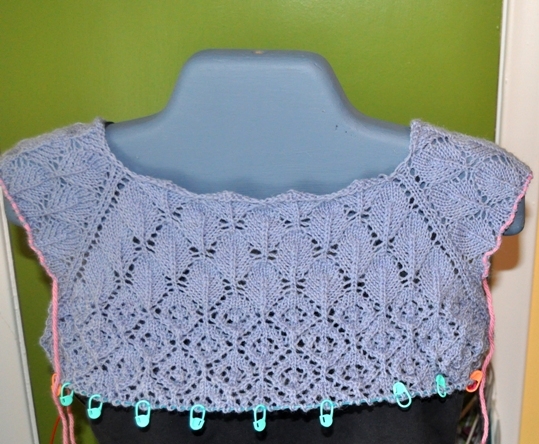
When I place my sleeve stitches on spare yarn at the bottom of the yoke my raglan patterned stitches will remain with the Body.

20190622_115854

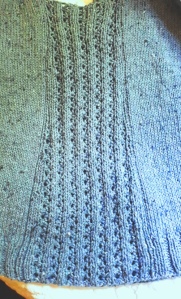
Now I can continue down the Body with a nice little pattern down the sides. This is a child-sized sweater so there are no underarm cast on stitches to consider.

20190623_140151

If this was an adult size there would be underarm stitches separating the two sets of  garter stitch patterns. More thinking might be required. I’ll leave that to you. Now I need to get going to finish the Body.

Cheers,

Deb

Any Gauge Patterns by Deb Gemmell

Cabin Fever Patterns and Books on Ravelry

Adding a Pattern to Raglan Lines

K. asked if it was possible to add a pattern in the raglan lines just as I did with the underarm stitches in What to Do with All That Stockinette. She had knit a sweater with patterned raglan lines but didn’t feel she could do it on her own.

Of course you could. Start with something simple and not too wide. I dug around my UFO projects and found one I had started.DSC_0543

Here’s how. Cast On at the top according to the pattern. Stop at the Marker Round (in the round where you are going to place the raglan markers). Do Not knit this round yet. Count across the stitches on your needle and with removable markers, place the markers as the pattern specifies. In the original pattern the marker for the raglan line would have been set up to be worked like this:raglan line

The set up would be to have one knit stitch before the marker and one knit stitch after the marker. The increases would be worked on either side of these 2 knit stitches. The Increase Row would read: Knit to 1 stitch before Raglan Marker, YO, K1, slip Raglan Marker, K1, YO.

Now get 4 more markers and move the markers so there will be more stitches at the raglan lines. I like to keep these knit stitches, YO, K1, marker, … extra sts…, marker, K1, YO in place since it makes reading the pattern easier to follow.

Decide how wide you want the new raglan lines to be. My Raglan Markers are 5 sts apart.DSC_0539

Now the Increase Row at each raglan line will read as:  Knit to 1 stitch before first Raglan Marker, YO, K1, slip marker, Knit 5 stitches, slip Second Raglan Marker, K1, YO. The increase set up is still the same. The only change is now there are several stitches between the 2 increase stitches at each raglan line.

You can put any number of stitches here depending on how many stitches you have in the Front, sleeve, Back sleeve and Front.DSC_0543

This is a really simple example and I’m sure you can improve on it.

Here is an excellent example of another simple idea where just making the raglan lines wider and staying with stockinette stitch still makes the Sunshine Coast pullover by Heidi Kirrmaier look fantastic.

Top Down Sunshine Coast Heidi Kirrmaier

Are you going to give this a try?

Deb

Any Gauge and GAUGE-FREE patterns by Deb Gemmell Mods

Cabin Fever patterns on ravelry

Deb on instagram

What to do with All That Stockinette Stitch

“All that stockinette stitch!” Yes I’m afraid so. Knitting Top Down can involve a lot of stockinette stitch once the excitement of the Yoke is done. What do you do to amuse yourself while you get all that knitting done?

Here is what I’m doing right now. I’m working a stitch pattern down the sides of the body across the underarm cast on stitches.

20190501_142011

These are Right Twist stitches which are 2 stitch cables worked without a cable needle.  Every 4th round I’m working: P1, work [P1, Twist Right] repeating to last 2 sts, P2. (Twist Right: K2tog and then without taking the stitches off the needle, knit into the first stitch, remove stitches.) This is keeping me engaged as I work down the body.

You could add anything here. Whatever it takes to give you something to keep track of and look forward to knitting. Knit, knit, knit, oh boy it’s the pattern, knit, knit, knit. Yeah, OK, it’s a little hokey but it does make all that body knitting move along quickly.

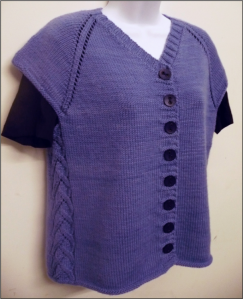
I realized, as I looked through my Cabin Fever designs, that I have been doing this for some time. The Side Pattern Vest (top down) was the first. There is a lovely lace panel down each side. That will keep you on your toes.

Side Panel Vest V-neck (2) - Copy

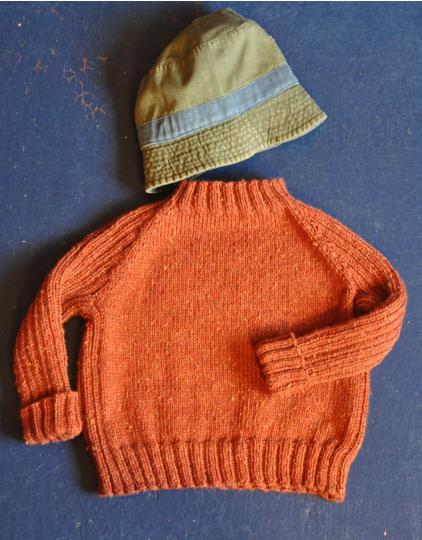
You could add a 2×2 rib down the sides. That works for this Child’s Ribbed Sleeve pullover.

Child's Ribbed Sleeve

I put one of my favourite stitch patterns in the Squiggle Lace Top . The Squiggle Lace pattern is based on a 2×2 rib where every other round you alternate between [P2tog, YO] and [YO, P2tog] worked in the P2 section of the rib. I’ve used variations of this pattern several times. Here I worked it over the underarm cast on stitches and even worked all the A-line shaping increases into the stitch pattern. Now that definitely gives you something to concentrate on.

Squiggle Lace Top

squiggle lace side

You are the boss of your knitting. Make it fun.

Thanks for reading,

Deb

Deb Gemmell’s Any Gauge patterns on ravelry

Cabin Fever patterns on ravelry

Ease, get the fit you want

I did a talk at a knitting guild last month based on the Any Gauge Raglan. I took them through the entire process from diving into their stash and casting on to figuring out how to get the Bottom of the Yoke to fit their unique body.

In the knitting industry we use the actual measurement of your bust (using a tape measure) + Ease to determine the final size of your sweater. One measurement. I know, it seems crazy. Obviously this one measurement cannot tell the whole story of your figure.

So I had everyone measure their Bust and their Arms. Almost no one had ever measured their arms. It’s important for your sleeves to fit as well as your body. I find that I need a slightly bigger sleeve than most patterns are allowing me for my bust size. I know from talking to many plus sized women that if they are busty the sleeves are often too big for them. Maybe you have found you can’t get both the bust and the sleeves to fit perfectly.

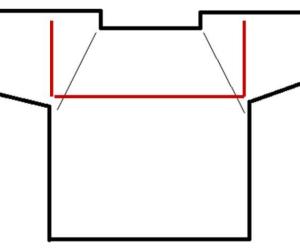
Body Measurement Workshop schematic

I have a solution. In the Any Gauge Raglan the raglan increases in the Yoke are worked until you reach the exact number of stitches needed to go around the Actual measurement of your Bust and both your Arms. At the Bottom of the Yoke it has to fit YOU because they are your measurements.

Any Gauge bottom of Yoke schematic

At this point the sweater would fit you like a second skin. If that’s the size of sweater you want you have it right there.

For a more relaxed fit some Ease (the amount your sweater is bigger than your actual body and arms) is added as you work the Divide Round as Underarm Cast On stitches. Again you get to decide how much ease you would like. Do you want a close fit or looser fit?

Close Fit:  Ease = 5% of Actual Bust measurement

Relaxed Fit:  Ease = 10% of Actual Bust measurement

Comfy Fit:  Ease = 15% of Actual Bust measurement

Loose Fit:  Ease = 20% of Actual Bust measurement

As you work the Divide Round half the Ease stitches are cast on at one underarm and the other half of the Ease stitches are cast on at the other underarm. That way the Total Ease you calculated above is added to the Body of your sweater. Ta, da, as simple as that.

The Any Gauge Raglan Yoke is worked to your personal measurements. Then you get to add the amount of Ease you wish for the fit you want.

Thanks for reading,

Deb

Any Gauge Patterns by Deb Gemmell

Cabin Fever patterns on Ravelry

Any Gauge Raglan, it’s done

Maybe you wake up one morning and decide today is the day you’re going to cast on for a pullover for yourself. It’s time. You go to your stash and pick out some yarn that has been calling to you. You check through your library of patterns at home or on ravelry to see if you have one that matches the pullover you want to make. Time passes, more time passes and you haven’t cast on yet.

What if you could get right to it. Cast on now. That’s what this Any Gauge Raglan pattern is all about.

Any Gauge Raglan Adult front page

I am a problem solving designer. One of my problems and maybe yours too, is that I don’t get gauge with the recommended needle size. I’m a loose knitter so usually go down one needle size to get close to gauge. With this pattern I am going to get to use the unique gauge I get with this particular yarn. One problem solved.

You can Cast On using the gauge information on the ball band if you usually get close to gauge with this yarn (I get close enough with the needle change) or you could do a swatch. Figure out the number of stitches you get in 1″ and you’re ready to Cast On for the neck opening.

DSC_0420

Yes, there is some math, more properly called Arithmetic. Nothing more than taking measurements in inches and multiplying by your Gauge (number of stitches in 1″). You can do this.

I’m really excited to present the Any Gauge Raglan Adult.

Thanks for reading,

Deb

Deb Gemmell Mods Any Gauge patterns on ravelry

Cabin Fever patterns on ravelry

Neckband Boss

Finishing up. Do you love it or hate it? The sewing in of the ends, the picking up of the neckband, washing and blocking, all of it.

I procrastinate. The time between finishing the actually knitting and finishing it up is usually a long time. I started this sweater in September, blush. But look at me now, I am finishing it up.

This was one of the early prototypes for the Any Gauge Raglan Adult and the drop at the shoulders was not as deep as I might like it. I lengthened it on the next sweater but right now I certainly don’t want the shoulder drop to be any shorter than it is.

DSC_0392 - Copy

The pattern calls for me to use a smaller sized needle, pick up for the neckband and then, since the neck opening is quite wide, to work an even decrease around the entire neckband, taking the whole thing in.

Who is in charge of this neckband? ME. That’s right, I’m the boss here. So, smaller needle, check. Pick up and knit stitches, check. Decrease Round, hmmm.

The neckband does need to be smaller so I decided that I need to decrease across the Front and Back only and leave the shoulder stitches as they are. Across the Front and Back I decreased 20% of the stitches and knit across the shoulders.

DSC_0392 - Copy (2) Yes, that brought my neckband in for a smaller neck opening and left my shoulder drop as long as I could. Finish knitting the ribbing and I’m done.

DSC_0397

The boss was right. I’m counting this as a success!!

Thanks for reading,

Deb

Deb Gemmell patterns on ravelry

Cabin Fever patterns

Aftermarket Neckband

The Any Gauge Raglans begin with the cast on of a large neck opening. It will seem really big. For the Baby sizes it’s 18″ around. For the Kid’s sizes it’s 24″ and for the Adult sizes the neck opening is 30″ around. The Neckband is knit last. There are a couple of good reasons for this. At least I think they’re good reasons.

DSC_0330

  1.  You can use ANY YARN for these Any Gauge Raglans. You can cast on with your best guess at gauge. Use the gauge indicated on the ball band if you know you’re usually close to gauge, close is good enough to get started. This large neck opening gives you lots of space to be a little tight or a little loose. No swatch, No problem. The adjustment for the final neck size is done later.
  2.  The Neckband is worked with a much smaller needle. The smaller needle will make the neck opening about 2″ smaller right away. Then, depending on how much smaller you need the opening to be, you can work a decrease round to pull the Neckband in an extra 5%, 10% or 20%. You can make the Neckband the size you desire.

DSC_0341

BONUS –  You can delay having to decide which stitch pattern you’re going to use to finish your sweater Neckband, Bottom Border and Cuffs. You may have a solid idea of what you want your final sweater to look like when you begin but when you see the Body finished you may have a new idea. Delaying the decision also gives you something to look forward to which I especially like. No need to decide everything all at once at the beginning.

I had a bag of chunky yarn, only 2 balls of each colour. No problem. I can work out something as I go so let’s cast on right now. As I progressed down the yoke I made decisions for when to start the second colour. This is a 6 year old size using 300g of yarn.

DSC_0377
Any Gauge Raglan Kid’s, size 6 years

The Any Gauge Raglan Kid’s pattern is now available on ravelry. Do you have someone between the ages of 4 and 12 who could use a pullover? Dive into your stash now.

Thanks for reading,

Deb

Deb Gemmell patterns

Cabin Fever Patterns

Place Sleeves for Any Gauge Raglans

When you knit a Top Down sweater, you choose the size using your bust measurement. Do the sleeves always fit? They quite often don’t for me.

I think I have solved this problem in the Any Gauge Raglan sweater series. I’m very excited to present the first one. This is a recipe style pattern where you do some math and work according to your own gauge. Tight knitter, loose knitter, it doesn’t matter. Your particular gauge matters.

I’ve started the Any Gauge Raglan series with a baby sizes, Newborn to 4 year old size:  Any Gauge Raglan Baby

What prompted this idea? As a designer, I would usually choose a set of sizes for the Body and Sleeves for each pattern. I would look at the set of sizes and work out the number of stitches needed for the Front, Back and Sleeves at the Bottom of the Yoke. Then I would work backwards up to the neckline to decide on the number of stitches for the neckline for all the sizes. The finished sleeve size dictates how wide the top of the shoulder is at the neckline.

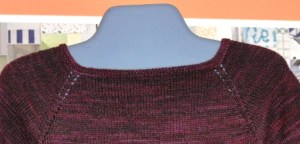
But what if I want a particular shape of neckline? In this case I wanted a rectangular neck opening with a wide shoulder.

DSC_0337

DSC_0330

The size of the shoulders on these neck openings is wide so that there is a drop down the front and back of the neck. After working all the yoke increases the sleeve may not be the proper size for the sleeve you need.  Oh, no, what to do?

What if … we used the Raglan lines as a guide only? What if … your actual sleeve needed could be wider or narrower than the Raglan Markers indicate? I mean, really, are the Raglan Markers set in stone?

I made a video to explain:  Place Sleeves on Any Gauge Raglans

This takes a particular set up which I am working on in the Any Gauge Raglan sweater series. I’m very excited to present the Any Gauge Raglan Baby/Toddler Pullover.

Use ANY YARN you want. Go ahead, dive into your stash and pick the perfect colour in any weight of yarn you have. Cast On and knit any size up to 4 years old.

What do you think of this idea? All comments, questions and photos are welcome. I can’t wait to hear your thoughts.

Thanks for reading,

Deb

Deb Gemmell patterns on ravelry

Cabin Fever patterns and books on ravelry

Double Decreases, which one to use

Lace knitting involves lots of awkwardness and sometimes you have to work to make it as pleasant as you can. There is a chart to read and if you screw up there you’re in deep trouble, yarn overs which can be easy to miss and decreases where the slant is important and needs to be kept track of. Lace knitting is beautiful, the more complex, the more beautiful. It’s hard to resist.

img_0284
The lace dress that I almost didn’t wear. My wedding glitch.

Can we remove some of the pitfalls? Knitting Techy Talk begins here.

First of all you need Markers. In the body of this lace sweater I was working 20 repeats of the pattern.  Without markers I could make a mistake in the second repeat and not realize until I didn’t have the correct number of stitches at the end of the round. That would be the end of lace knitting for me, right there, that round. The knitting would be winging it’s way across the room as the air turned blue. I did that with my first lace project. I have learned a few things since then: Use Markers.

dsc_0039

With markers after every 10 stitch repeat, how far wrong could I go? Believe me I corrected quite a few errors within those 10 stitch repeats as I was knitting this top but I didn’t have to rip rounds back. (OK, I admit there was that one section I had to rip back but I was already so far down that I didn’t mind doing it.)

Unfortunately, for this stitch pattern the markers created a problem. Sometimes you just can’t win.

dsc_0091

double decrease blog post, 123


The Double Decreases (the inverted V) at the end of the repeats are the problem. Once the markers are placed the Double Decreases used in this pattern are awkward to work. The 3 stitches involved in this decrease are numbered on the chart and you can see that the Marker is between stitch #2 & stitch#3. There lies the problem.

This pattern uses this Double Decrease: Slip 1 stitch knitwise, knit 2 stitches together, pass slipped stitch over. Easy enough until … you add in markers for each repeat.

dsc_0155

double decrease blog post, 123

This is really how it works: slip stitch#1 knitwise, slip stitch#2 purlwise, Remove the Marker, Replace slipped stitch#2 back onto the Left needle, knit 2 sts together (sts #2 & #3), pass first slipped stitch over and Replace the Marker. AWKWARD.

I decided there needed to be a change. You’re allowed, I’m allowed, we’re all allowed to mess with patterns. I changed that Double Decrease to a Center Post Double Decrease.

Center Post Double Decrease:  Slip 2 stitches together knitwise (sts #1 & #2), knit 1 stitch (st#3), pass 2 slipped stitches over.

dsc_0161

With the markers in place this really works as:  Slip 2 stitches together knitwise, Remove Marker, knit 1 stitch, pass 2 slipped stitches over, Replace Marker. DONE.

Yes, it looks different but the ease of knitting made it totally worth the change.

I like the result.

Thanks for reading,

Deb

My patterns on Ravelry

Shawl to Sweater

Do you have a favourite shawl stitch pattern that you love? Have you ever wondered if it could be used to jazz up a raglan pullover? Could you work with a plain sweater pattern and make it your very own design? That is just what I’m trying now.DSC_0039

I have a reliable Top Down straight-necked Raglan pattern which I will be publishing in the new year. I’m knitting a lace version to wear to the upcoming wedding.

I’m using a couple of triangle shawl stitch patterns from the Knitting Lace Triangles book by Evelyn A. Clark. I have knit the pattern for the Leaf Shawl by Evelyn A. Clark several times already and I know it is perfect for this.Leaf shawl evelyn a. clark IMG_0128_medium2

A triangle shawl knit from the top down is actually two triangles with a centre stitch between them.triangle shawl direction of knitting schematic

Each triangle has two increases worked every other row. One increase at the beginning edge and another increase at the far side of the triangle.triangle shawl increases schematic

Does this sound familiar? Yes, a raglan Front for instance, has an increase worked at the beginning and outside edge, every other round. The sleeve works the same way. Could this work?shawl to raglan schematic

Start your shawl pattern part way down the chart so that the stitch count fits into the stitch numbers for the section of the raglan pullover where you wish to place it. You may have to adjust your stitch numbers to accommodate the stitch pattern.shawl to raglan begins schematic

Here is my sleeve at the divide. I’m working the Leaf pattern from the Knitting Lace Triangles book by Evelyn A. Clark.DSC_0031

I also worked it on the Front and Back with two more repeats of the pattern.DSC_0036

OK, call me a knitting overachiever, I then transitioned into the Medallion pattern which will continue to the bottom of the sweater. It’s an exciting knit.

Do you have a favourite shawl stitch pattern? Would you like to be using it in a sweater?

Thanks for reading,

Deb

ANY GAUGE and GAUGE-FREE patterns by Deb

Cabin Fever patterns on Ravelry

Deb oninstagram