How to Choose a Size

How do you pick a sweater size when you are going to do some Bust Shaping? Most knitting patterns are set up with the Front and Back the same width. That works great if you are not curvy. If you are curvy, you want to add extra width to the front only where you need it. You do not need it in your shoulders or neckline. But which size do you knit?

The knitting industry uses the measurement across your bust for choosing the finished size. Add some ease and choose the nearest size to knit.IMG_5843

If you are going to add inches for bust shaping you need to begin with a different size. The simple answer here is to make a smaller size and add the needed width across the bust so that your sweater fits just like you want it too.

If you are knitting Top Down, you can use one, or combine two, of the Bust Shaping Methods here:

Knit to Fit: Top Down Easy Bust Shaping

Knit to Fit: Bust Dart, Top Down

Bust Shaping with Twin Stitches

A more accurate way to measure for your size, might be to use your upper chest measurement. Add some ease to that measurement and choose your size.IMG_5846

My manikin, as you can see, does not have a big difference between her Upper Chest and Bust measurement. It must be a manikin thing.

Here is what I would do. I have a 3-4″/7.5-10cm difference between my Upper Chest measurement and my Bust. Usually sweater pattern sizes are set up in 3″/7.5cm increments. Ideally I would like an inch and a bit of ease added to this Upper Chest measurement. I would begin my Top Down sweater using the stitch counts for one size smaller than I really need according to my Bust measurement. I would work the neck down to just above the bottom of the yoke. The neckline and chest should fit nicely. Then I would decide which method I want to use for adding Bust width and continue to work, adding around 2″/5cm (and a little bit more usually) at the bust.

I then have the proper size according to my Bust measurement but more of the width is across the Front where I need it, for two obvious reasons.

Thanks for reading,

Deb

P.S. We do have two books where the Bust Shaping is included (built in to the finished sizes). In the Need A Plus Cardigan book the fronts are 3″/7.5cm wider than the back. In the Need A Circular Yoke the front is 2″/5cm wider.

ANY GAUGE and GAUGE-FREE patterns by Deb

Cabin Fever Patterns on ravelry

Deb onInstagram

Raglan Increases 5 ways

There are so many ways to work every possible technique in knitting that you could, if you are adventurous, view a knitting pattern as a guide rather than written in stone. The ability to substitute different techniques to get a slightly different look means that many more patterns are available for you to use to get the exact garment you had in mind. This also, by the way, could save you quite a bit of time when choosing patterns.

If you are knitting a raglan pullover or cardigan here are 5 ways to work the increases that make the distinctive raglan lines. Do you want decorative holes, small holes or no holes at all? Keep in mind that an increase that is easy for you to work also makes the sweater a happier knit.

Continue reading “Raglan Increases 5 ways”

Substitute in Twin Stitches

The pattern you have chosen to knit is a Top Down with a shaped neckline which you really like … Can you hear the “but” coming? But … it uses short rows that you don’t like. There are at least 5 ways to work short rows and they had to choose that one?! How could they do that knowing that you don’t like working them that way?

Or maybe you have a pattern you like a lot and would like to make a new one, the same but different. I really like the Take It From The Top sweater. I have two already that I wear a lot. Now I would like to change things up for a brand new sweater. This basic pattern is a great starting point. I’m planning on having some fun with this. Would like to join me and Knit A-Long?

Take It From The Top photo

Sometimes techniques that are awkward or unrewarding can stop you in your tracks. The pattern had so much potential and now that you’ve started you are less than impressed. You gaze over at the time-out corner and wonder if it will be headed that way.

But wait. You have more know-how than you realize. Since there are usually several ways to do every technique in knitting, you could find another method to substitute, one that you are more familiar with or learn a new way which is it’s own reward.

I’m going to change the short rows and add a stitch pattern down the front, add bust, waist and hip shaping and maybe do something weird along the imaginary side seam. I’ll be expanding on more modifications and answering questions on the Knit A-Long.

After working the neckband, consider the short rows. Short rows are used to lower the front of the neck which makes the sweater more comfortable to wear. We actually work more rows across the back of the neck, raising the back of the neck, to lower the front. No one every says that but that’s what is really going on.IMG_5759

NACY short row neckline
Neckline to show raised neck, from Need A Circular Yoke book

The Take It From The Top uses the most basic of short rows to shape the neck. *Knit around the short row as written, Turn to wrong side, slip the first stitch, purl around as specified and Turn to right side, and slip first stitch; repeat. This totally works and if you have never done short rows before this is as straight forward as it gets. These short rows  work best when the yarn has some distracting elements: texture or colour variation. They are not the most sophisticated of short row methods.IMG_5754


I am changing to Twin Stitch Short Rows (video) which we used in the Need A Circular Yoke book. They are one of my favourites. They are done by knitting into the row below, pulling the loop up and slipping it back onto the left needle. You then have 2 stitches coming out of the row below, twin stitches.

TWK insert needle 2 - Copy (640x632) (525x381)

TWK completed (640x585)

When you next come to them you knit the twin stitches together. Yes, it’s that simple. I love when techniques are simple and look great. Why complicate things?

IMG_5775

Substitute in a Twin Stitch for the stitch before the Turn (K1, twin stitch, Turn). That’s my first change up.

Next add in a panel on the front with a stitch pattern. I’m looking forward to this. Thanks for reading. Join me on the KAL if you want to knit along with me.

Deb

ANY GAUGE and GAUGE-FREE patterns by Deb

Cabin Fever No-Sew patterns

Deb onInstagram

How many knitting books is too many?

Do you have enough knitting books yet? I have a huge stack even after I went through them and discarded quite a few. Heartbreaking but necessary. Some books served their purpose at one time but now I will not be going back to them so they got donated to my public library. Hopefully a knitter new to them will pick them up.


What are your favourite books?

Some excellent knitting books that survived:

Knitting Around by Elizabeth Zimmermann

Check out the Knitting Around patterns in the book. If you are looking for books where you will learn about the basics of knitting, you can’t go wrong with any of Elizabeth Zimmermann’s books. I counted today and I have knit 11 different garments out of this one book alone (the Mystery Mittens are the best!). I would highly recommend the Moccasin Socks for something different and we all seem to be trying out new ways to knit socks.


It’s still mitten weather. I have knit all of the mittens in this book. The Norwegian Mittens are beautiful.


Knit to Flatter by Amy Herzog


This is not a book I own but I have read it a couple of times and can recommend it. I have also never knit anything out of it but lots of knitters have posted projects on Ravelry. I think she appeals to a younger crowd than I. The most important part of this book for me was the section on picking the correct style for your figure. Sweater success starts with picking the neckline and shape of sweater which will flatter your figure. She also points out that how you look in the mirror, head on, may not entirely tally with your measurements. I am much less hippy when looking in the mirror than is indicated by my measurements. Choose a style according to the mirror and then work with your measurements to make it fit. Great advice.

Knitting Lace Triangles by Evelyn A. Clark

KnittingLaceTriangles_2ndEdition_Cover_small

This book is based on a workshop for knitting triangular shawls. I have knit from this book several times. It’s wonderful. What I love about it is the freedom of choosing different stitch patterns and the wonderful way she has set up transitioning from one stitch pattern to the next. Amazing. Mix and match the patterns, every shawl is different. Work them in stockinette stitch and then in garter stitch and see the difference the wrong side row makes.

Do you have some recommendations? I love to hear about books I haven’t seen yet.

Thanks for reading,

Deb

ANY GAUGE and GAUGE-FREE patterns by Deb

Cabin Fever No-Sew patterns

Deb onInstagram
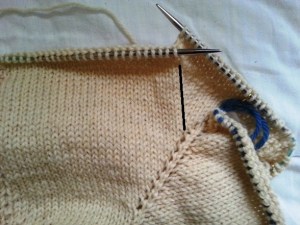
Easy eh?

I am working on the Easy A by Kat Riddell, a garter stitch sweater with a KAL (knit along) on ravelry. I love garter stitch and this looked like it would be a perfect spring sweater.IMG_Easy_A_medium2

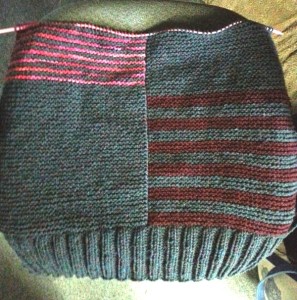
I had some Heritage by Briggs and Little and one ball of hand dyed by Essence of Autumn in my stash. Well, not exactly in my stash. It was masquerading as a partially knit sweater in the time-out corner. The sweater had severe gauge problems and sitting in the corner did not seem to be solving them so I undid the sweater, steamed the wool and decided to rework it here. I knew I didn’t have enough green so I thought I would add stripes on the body since I had a ball of these two other colours.005

Then as I was thinking about stripes, I just happened to see a women wearing a top where the stripes on each side of the front were different widths. Perfect.

To my mind the stripes started as Maroon and Green, Maroon and Green. Then I started on the pink stripes. My first attempt did not work. Even I could see that the last green stripe did not appear as a stripe.20180116_115414

Second time lucky. I am quite happy with the results.

IMG_5700

IMG_5691

I am seriously running out of the green. Oh, no, was my first reaction but I still had lots of the other  two colours. Working the sleeves in one colour of pink did not look good. I ripped them back and now I’m on a roll with striped sleeves. At least the first one.IMG_5701

Stayed tuned as I play yarn chicken.

Thanks for reading,

Deb

ANY GAUGE and GAUGE-FREE patterns by Deb

Cabin Fever No-Sew patterns

Deb on Instagram


Bust Shaping with Twin Stitches

The best part of writing a book for me, is discovery. There is always something that I learn that makes the book special. It may be a small detail that you, the knitter, might  never notice. It might be one pattern that was especially interesting to develop that is the highlight. It won’t necessarily be the most popular pattern in the book but it will be special to me.

In the Need A Circular Yoke book I had an “aha” moment. We, Elizabeth Fallone and I, discovered that the short row system using Twin Stitches which is usually used to turn the heel of a sock, could be used to raise the back of the neck. That’s not the moment though. I also discovered that it could be used in a different way to shape the bust. Short Rows can be used for bust shaping to make the Front longer to compensate for a larger bust, that’s not new. We didn’t do that. We didn’t use the short rows themselves. We used the Twin Stitches from the short row system to widen the Front so there would be less pull-up on the sweater.NACY bust dart w arrow

Imagine if you could accurately position the bust shaping. You want to work increases to  widen the Front of your sweater so that the fabric is at its widest just above the widest line across your bust. I work from the Top Down so I am always trying to position the beginning point of the bust dart the correct distance from the underarm of my sweater. Not too high above my bust line and I definitely do not want to start the dart too low and run out of room.Bust shaping w twin stitches

The twin stitches allow you to work an increase every round. In knitting, we don’t have very many increases that work well when worked every round so this was a find. When you can work an increase every round you can know accurately how much vertical room these increases will need.

Working with worsted weight yarn (because the math is easy) let’s say you want to add 3″/7.5cm to the front of your sweater. That would be about 8 stitches on each side of the Front for a total of 16 sts added to the front. Your row count for worsted weight yarn is 7 rows = 1″/2.5cm so working 8 increases over 8 rounds would take just a smidge over 1″/2.5cm (1.14″/3cm to be exact). Ta, da. Start your twin stitch increases just an inch and a bit above the widest part of your bust.NACY bust dart

What is a Twin Stitch? It’s a “Knit in the Row Below” stitch where you hold onto the loop you made in the row below and use it as an increase. You do not pull off the original stitch on your left needle (the stitch you knit into the row below of). Wow, that’s really confusing. It’s much clearer on my video. Check it out.

Here’s the link for  Twin Stitches for Bust Shaping on a Top Down Pullover  as used in the Need A Circular Yoke book by Cabin Fever where we made the Front of these pullovers 2″/5cm wider than the back.NACY cover

Have you used this system? Did it work for you?

Thanks for reading,

Deb

ANY GAUGE and GAUGE-FREE patterns by Deb

Cabin Fever patterns on Ravelry

Deb on Instagram

A Mystery

I’m fascinated when I see a traditional garment worked in an entirely different way. How did they come up with this idea? Was there a process the designer has gone through to make this breakthrough? Is it a breakthrough at all? I mean do we need to work this garment in some strange way? Was it just the whim of a designer with too much time on their hands?

I know, they are just there to mess with my head.

This is the beginning of a mitten. “Yeah, right”, you say.IMG_5670

How does this turn into a mitten?IMG_5671

It’s a mitten cast on in the oddest place. I have no idea how this came to be. You might have guessed that this is a design by Elizabeth Zimmermann. She called them  Sideways Mystery Mittens .

When you fold this weird garter stitch thing you get a mitten. I was truly amazed the first time I knit these.IMG_5674

But after knitting several pairs it was “ho, hum, so what”, ha, ha, NOT.  They are still amazing no matter how many pairs I’ve knit.IMG_5675

Then I modified them of course because I just can’t let well enough alone. I added short rows to the back of the hands, I felted a pair, added stripes to another and then made them in different weights of yarn and sizes. I never figured out how she came up with the idea in the first place. A mystery still.

Share if you enjoyed reading this. Leave a comment if you’ve knit these or would like to. Thanks for reading,

Deb

ANY GAUGE and GAUGE-FREE patterns by Deb

Cabin Fever No-Sew patterns

Deb onInstagram

Vertical Darts Top Down

The holidays are over. Is it time for you now? Are you knitting a sweater for yourself? It’s a long winter. I’ve got a couple started because, as you know, that’s the most exciting part.

If it’s a sweater for yourself how much bust shaping would you like to add to a pattern that doesn’t include any?

Adding a couple of inches to the bust on a Top Down sweater is fairly straight forward. But what if you wanted to add more than 2″ in total across the bustline? Could you start your bust increases in the Yoke while still working the raglan increases and then continue them down into the body? Vertical Darts work from the Bottom Up, why not from the Top Down?

Since I raised this question I decided I had to try it out. I started working the bust shaping increases when I still had 8 rounds left to work in the Yoke. This is the same strategy as the Top Down Easy Bust Darts but this time the bust increases are worked in a vertical line away from the raglan line. The vertical line of increases will allow me to continue to work bust increases until I have reached the largest point of my bust. (This schematic is an approximation – the raglan and bust increases are worked in the same round – dots on the schematic make it look like the bust increases are worked more often, they are not.)

Bust shaping Top Down increases showing high bust

I worked a raglan increase and a bust increase on each side of the Front for the last 4 Increase Rounds before I divided for the underarm. After the Divide I continued to work the bust increases 4 more times for a total of 8 increases on each side of the front giving me 3″ of extra width.bust shaping in yoke

My main concern was what would show.019

While the increase line is visible it is not so noticeable when I’m wearing the sweater (or when my best girl is wearing it) and the extra room is well worth the effort.021

This was easier to do than I expected. It shows but only as a dart which is acceptable. I got quite a bit more bust room because of it. I’m really happy with the result.

How about you? Could you add this into a Top Down raglan?

Thanks for reading. Cheers,

Deb

More reading on Top Down Bust Shaping:

Do I Need Bust Darts?

7 Reasons to Double Up the Increases for Bust Shaping

How Do You Want Your Sweater to Fit?

Bust Dart, Top Down

ANY GAUGE and GAUGE-FREE patterns by Deb

Cabin Fever No-Sew patterns

Deb on Instagram

Plain Sock, Striped Sock, New Heel

Christmas is coming soon and I can’t do much else now but work on finishing up the projects that I planned to make. This year it’s socks. I wanted to make 4 pair. I started quite a while ago, I’m not crazy enough to think I could get these done quickly because that would take all the fun out of them and I intended to have some fun. Why not?!

In September I made my first pair in my regular sock way: Toe Up with a Star Toe and a short row heel. That’s my standard, no-thinking sock method.

20171201_083838

Next, I had a second ball of the same self-striping wool and thought to add in another colour and work stripes-on-stripes to see what would happen. What could go wrong? They would still be wearable socks, right?

I worked Spiral stripes (check out the link for my other diary-type blog where you’ll see I knit Spiral Striped socks for Christmas 2015 using 3 colours). This time I worked them with two colours and picked one spot at the side of the foot to change colour every round. The trick here is not to twist the yarn but to pick up the new colour from the round below and continue to knit the next round without twisted the colours around each other.

20171201_083945

These two socks are worked using the same Toe-Up knitting method and the same main colour self-striping yarn but the second pair has a navy contrast colour added (different size for a different person).

I’m so pleased with how these striped socks turned out. I have several 50g balls of sock yarn to use up and this works wonderfully well.

Next pair, same stripes because now I’m smitten. Cuff down this time just to mix it up.

20171214_101728

Confession time, I’m getting a little bored. Time to try a new-to-me heel.

This V at the back of the heel takes the place of a gusset. Work increases on either side of the centre two back of leg stitches every other round until you have doubled the number of back of leg stitches minus 4 sts.  Work the increases into a stitch pattern if you wish just like I did. I learned of this method from the Vanilla is the new Black pattern.

20171214_101926

Now work the regular V-heel turning. Knit to the centre of back of leg stitches, K2, SSK, K1, Turn. Slip first stitch, P5, P2tog, P1, turn. If you are a sock knitter you can take it from here and finish your heel turning when you have reached the original number of stitches.

This gives you a deeper heel turning which I think is a real advantage.

20171214_104050

I’m in love. I think I can have some more fun with this heel. Maybe cables or twisted stitches on the back of the heel worked in with the increases or … maybe work the increases radiating out in a V instead of on either side of those centre sts.  Or maybe …

Stop, stop, stop! I have to finish these socks first. Now I have the carrot of trying something else dangling in front of my needles. Good incentive to finish.

If you are knitting for Christmas, good luck. May the knitting fairies favour your efforts.

Merry Christmas, Happy Holidays and thanks for reading,

Deb

https://www.ravelry.com/stores/cabin-fever-patterns

http://cabinfeverknittingdesigns.blogspot.ca

ANY GAUGE and GAUGE-FREE patterns by Deb

Cabin Fever No-Sewpatterns

Deb onInstagram


Gauge Free Playing

I am in the middle of must-get-finished Christmas knitting. In spite of this schedule, I’m taking some time to play with a Gauge-Free triangle. I have no one in mind for this, maybe it’s for me?!

That’s not really it. The real reason I’m taking a break is because we are in Ottawa watching our daughter play in the Roar of the Rings (curling playdowns to decide who gets to be Team Canada at the Olympics) which is a roller coaster of emotions and not so good for my knitting. As you may imagine it’s a little tight in places, ha, ha.

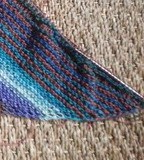
This triangle will become an asymmetric shawl. I dived into my stash and found a ball of Noro Silk Garden Sock which is colourful and will make a lovely summer wrap. It’s only 300m, not enough, so I also found a ball of Louett Linen which should go well with it.

So here goes. I started with the Silk Garden, working an increase at the beginning of one row and knitting back. That’s it. The yarn is doing all the work.20171203_123111

Then I started working stripes with the Linen.

20171204_100254 - Copy


The problem is carrying the yarn you’re not using for those two rows. I have decided to knit the last stitch of the second knit row with both colours. It makes that edge a little thicker but I don’t have any yarn looping on this edge.


Now I’m adding in a purl row. I really like the look of this. It makes one colour the background which is effective.

20171204_100202

With the Linen I’m working one knit row and a purl row then 2 knit rows of Silk Garden. This should take me through today’s game. Then I think some “K2tog, YO” yeylets are in my shawl’s future.

There is nothing I can do wrong here. This shawl let’s you play with stitch patterns and colour. It’s freeing. Maybe this is for you too.

Thanks for reading,

Deb

ANY GAUGE and GAUGE-FREE patterns by Deb

Cabin Fever No-Sew patterns

Deb on Instagram