One more Family Crew Neck and some thoughts about Circular Yokes

It’s time to get started on my 2025 knitting. Have you started? I’m a little late to the party but I had to clear the decks, so to speak, and get those WIPs out of the way. Well, not out of the way exactly, but finished and delivered to the wearers, one of which is me.

Now I am starting on a request from my grandson for a rainbow sweater. It’s another Family Crew Neck, my 6th one. The modification for this one will be rainbow stripes. If you haven’t tried this pattern because of the math, I’ve done a video for the beginning cast on which shows my math for a 4 year old size. You can follow along over the coming weeks.

Also in the works is a top down circular yoke sweater. In the works at this point means I think about it at 3 a.m. There are so many ways to tackle a circular yoke. How could I work the yoke increases? Should I set up 8 or 12 markers and increase there every x number of rounds, as I work down the yoke? Maybe I could do a round with many, many increases and then work straight to the next round of many increases?

I have made 2 decisions so far. I am starting this circular yoke with an I-cord for the neck opening edge.
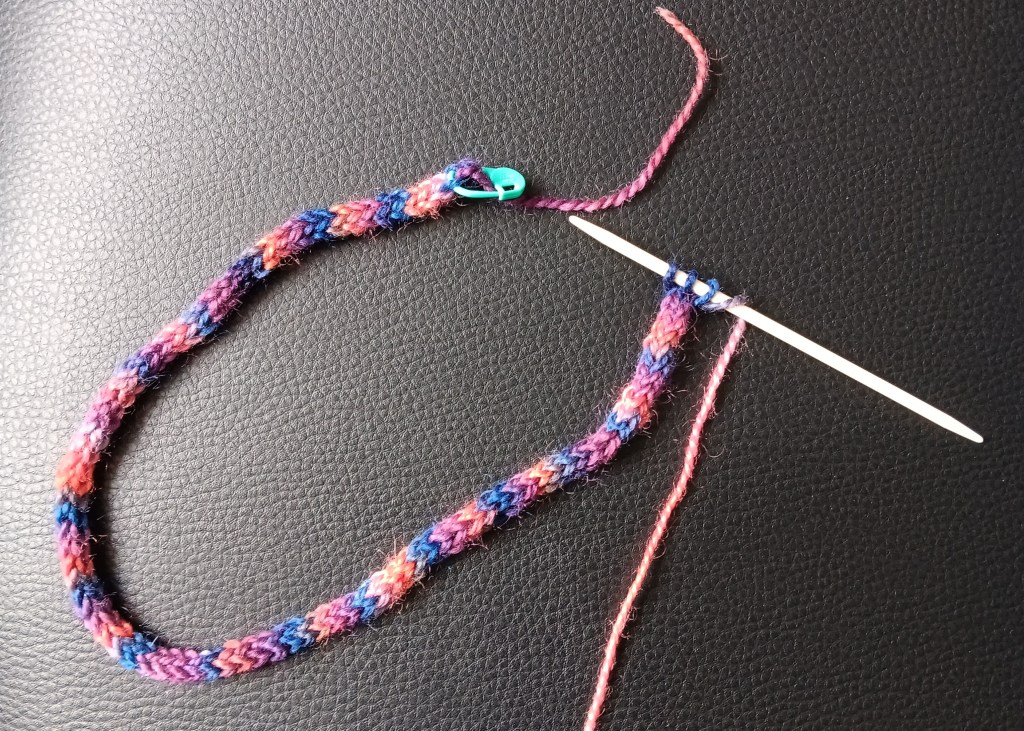
Then I am going to work in stripes of 2 rounds of variegated wool and one round of brown, worked in the helical method.
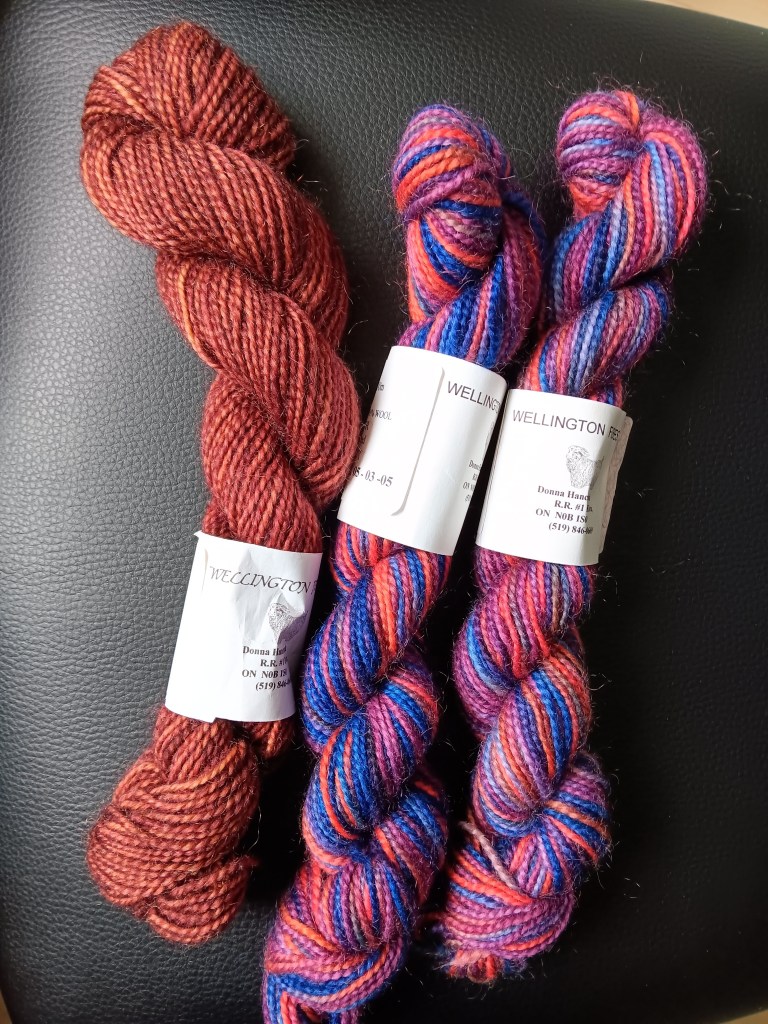
If you haven’t tried this, it’s a fantastic way to work one round stripes. Stay tuned. A video may be coming your way.

Cheers, Deb

Any Gauge and Gauge-Free patterns by Deb

deb.gemmell on instagram

Stretchy Cast On

The construction for working the Family Crew Neck raglan begins with the neckband. This makes it different from a lot of other Top Down patterns. Once the neckband is knit, short rows are worked to create a neckline where the front is lower than the back.

Because the neckband is worked first it’s important that your cast on is especially stretchy. Quite often the neck opening of a crewneck is smaller than your head circumference. It’s not a great feeling to rip your ears off as you pull your sweater over your head. Especially if you’re working a sweater for a child.

I’ve looked for some videos for stretchy cast ons. Here are the ones I use regularly.

Many stretchy cast ons are based on the long-tail cast on and I found the third one mentioned in this video to be the best (found at 5:10 into the video). Three Wasy to Make A Stretchy Cast On I used it here and since I use the long-tail cast on all the time, I found the third method really easy to work. I think it looks great with K1,P1 ribbing and it is indeed, very stretchy.

Another great cast on is the Crocodile Cast On by Cat Bordhi which is also based on the long-tail cast on. This is my usual cast on. It is stretchy too.

The beauty of starting with the neckband is there is no picking up afterwards. I count this as a big advantage.

Would you rather pick up the neckband? Are you good with starting with a stretchy cast on and going on from there?

Cheers,

Deb

Any Gauge and Gauge-Free patterns by Deb

Mid-sweater Block

I’m knitting a sweater for my son-in-law (Family Crew Neck) at his request. I was so very pleased to be asked. I have measurements and am ready to go. But this has turned out to be a challenge.

I’m trying out a new-to-me yarn and to be a good little knitter, I knit a swatch. I changed needle sizes twice and now have gauge. I even washed it. Pat on the back, I am being very, very good! I cast on.

Part way through I started to panic. It’s small. I did all the math again and then three more times and as far as I could tell the body is around 2″ smaller than it should be. I kept measuring it over and over, hoping it would be a little bigger each time. Ha, ha, I bet you’ve never done this.

Then the light bulb went on. I have a swatch. I find them somewhat unreliable at the best of times but this time I had one to blame. I measured my gauge on it and then on my sweater and … I had tightened up. This never happens to me. I am a really loose knitter. I was working with needles 2 sizes smaller than recommended to get gauge on my swatch and now I was telling myself that that was a mistake.

Hmmm, I washed my swatch just like I’m supposed to. Ah, ha. Another light bulb moment.

I dumped the whole sweater in the sink, needles attached and all, spun it out in my washing machine and laid it out (nice and neatly, not like this photo) and let it dry.

Voila, it relaxed and although it’s still 1/2″ smaller than I would like, it’s going to be fine. Phew.

I’m on the sleeves right now. I took out 1 round of knitting and started with new yarn. Here’s the difference in gauge. You can see that already the new section of the sleeve has a tighter gauge. I’m trying not to look at it.

Ignore the marker. That was for counting rounds so the sleeve stripe will be the same length as the body stripe.

I’m hoping to get this done this week. I don’t know if that’s possible but I’m giving it my best shot. Audio books, short walks and lots of knitting.

Cheers, Deb

Family Crew Neck raglan pullover

Any Gauge and Gauge-Free patterns by Deb