The Family Crew Neck

The Family Crew Neck pullover is ready to leave home. I’ve hit the publish button so if you’re interested in knitting top down pullovers for every person you know in different weights of yarn, it’s ready to go.

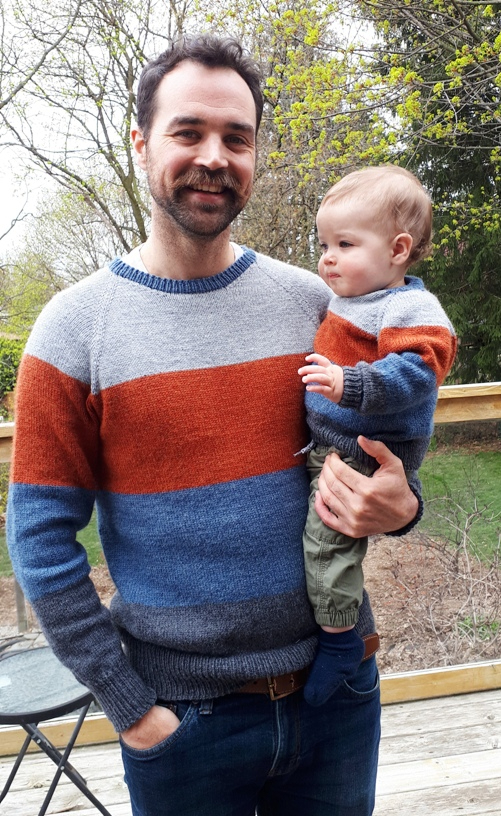
I’m knitting #5 right now. I’ve knit a striped one for my son-in-law, a matching mini-me one for my grandson, a salt & pepper pullover for my son’s girlfriend, a twisted stitch patterned version for my daughter and now, of course, one just one more for my grandson (it’s a grandma thing).

This pattern is a framework for you to play with. There is MATH. Yes, sorry but no getting away from it since it’s for ANY GAUGE of yarn and I don’t know what you’re knitting with. All the body measurements are in inches, which you then multiply by your stitch gauge and voila, stitch numbers, just like that. It’s not hard, really it’s not.

I thought I’d take you on a tour. There may be some weird and wonderful things that are a bit different from top down sweaters you’ve done before. This is a system I’ve devised and used for years.

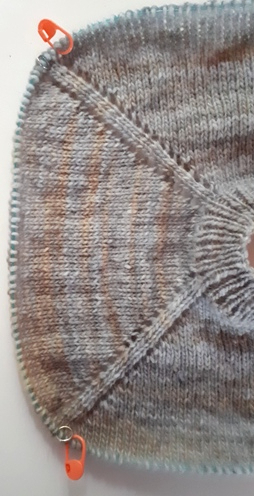
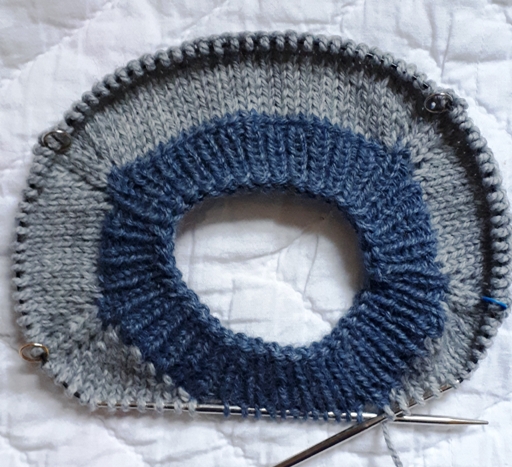
Here’s the Family Crew Neck . I don’t like picking up stitches, so this pullover begins with the ribbed neckband. It’s all one piece from the beginning. You’ll need a nice stretchy cast on because most neckbands on crew necks are slightly smaller than your head. Do you see me using the magic loop method here? I can learn! It allows for better photos so I’m figuring it out.

Now, work short rows and raglan increases, two things at once. I’m hoping you’re enthusiastic to get going. I always am.

The short rows produce a drop at the front of the neck. The raglan increases are … well, raglan increases. I always think of them in pairs, one before the raglan line marker and one after.

Every Increase Row starts one stitch before the Beginning of Round Marker (yellow) so you can do the pair of increases, one before and one after the marker.

The short rows get longer and longer as they creep down the Front on both sides. The Beginning of Round Marker is at the left front shoulder. A weird place but the short rows work this way.

Still creeping further down the front. Note that the centre front stitches do not get worked until the very end.

And done. Look at that front drop. I love this moment. Do you have moments when you sit back and say ‘just look at that, I did it’?

The tour continues next week with The Great Divide. Another exciting moment, ha, ha, can you stand it?!

Hope you’re having as much fun as I am,

Cheers, Deb

Any Gauge and Gauge-Free patterns by Deb

Deb on instagram: deb.gemmell

Working a Panel of Stitches

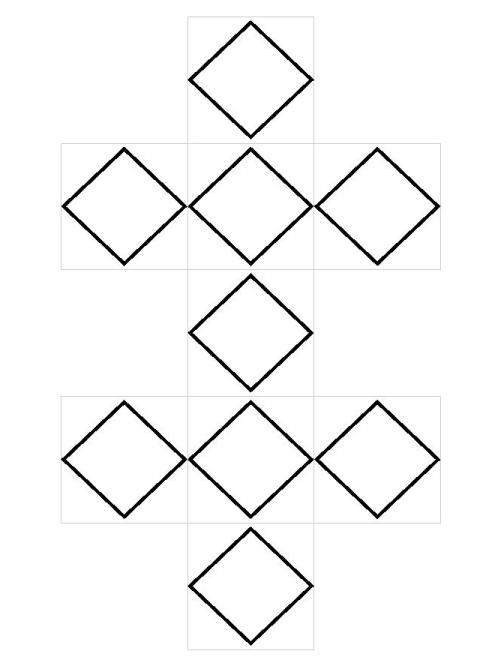
My Family Crew Neck, a pattern-in-progress, is a Top Down pullover which lends itself to working a stitch pattern down the front. The panel can be as wide as that short flat section at the bottom of the crewneck shaping. I’ve been playing with a twisted stitch pattern that makes a diamond. Because I usually use a chart, and the chart is square, I’m thinking of it as a diamond in a box. Only the diamond actually shows but … well my mind won’t make the adjustment.

The little stitch pattern I’ve included in the pattern is 6 stitches wide and 15 rounds high for one diamond.

The easy way to work this as a panel across the 18 stitches I had available on my adult pullover would be to work 3 boxes across and repeat them down the front. Like this:

This is two diamonds high.

Logical and it would look good. But … did I do that?

Three guesses. If the first guess was NO, then you know me pretty well. I decided to do this:

Sometimes I complicate things (are you laughing?!) and live to regret it. Not this time. I had a great time doing this weird zigzag. It was not without the occasional rip back but having to concentrate was not a bad thing.

Now I am contemplating doing a little kid size in a thicker wool. I won’t have many stitches in the centre of the crewneck to work with so I’m contemplating doing this:

What do you think?

Hope you are also having fun with your knitting,

Deb

Family Crew Neck pullover

Any Gauge and Gauge-Free knitting patterns by Deb

Deb on instagram: deb.gemmell

Salt and Pepper Crewneck

This Any Gauge Family Crew Neck was a fairly quick knit. Nice big needles and an interesting wool for a plain pullover. Now that I have a basic sweater done I can get down to finishing my pattern. No more procrastinating. I’m taking on the challenge of making this pattern for all sizes. This is new for me and something of a formatting nightmare. How do I put in all the information for all the sizes and not overwhelm the knitter who is only knitting one size? Hmm, lots to learn here.

I used Briggs and Little Heritage, Threaded G+W. I knit it at a slightly looser tension (15 sts = 4″/10cm as opposed to the recommended 17 sts = 4″/10cm) for a nice drape. I’m very happy with it.

One more Family Crew Neck pattern prototype is done. I’m going to deliver it this week and will have some photos next week. Now to cast on the next one.

Right now I’m taking a moment to feel the satisfaction of a sweater finished. Don’t you love that feeling?

Cheers and hope your knitting is going well too. Deb

Any Gauge and Gauge-Free patterns by Deb

Dividing yarn for body and sleeve stripes

Working a sweater with big stripes is a great look. If you have tons of yarn available it’s not a problem to get equal sized stripes on the body and the sleeves. I made sure I bought enough. Knitting this prototype for the Any Gauge Family Crew Neck Raglan sweater for my SNL was really fun.

Then I decided to knit a mini-me sweater for my grandson with all the odd balls I had left over. Now I have a limited amount of yarn to work the body and sleeve stripes.

How do you divide your yarn so you’re sure to have enough for the sleeve stripes while you’re working the body? I didn’t want to knit the body sweating about the sleeve stripes. I wanted a nice relaxing knit.

If you have a scale to weigh your yarn and you have decided on the finished size of the sweater, you can follow along. Here is how I did it for my sweater sized for a 1 year old:

Formula: weight of yarn available = body circumference + sleeve circumference + second sleeve circumference.

Now the calculator comes out: Divide the grams of yarn by the total circumference of body and sleeves. This will give you the number of grams of yarn needed to knit once around the body and two sleeves.

Here are the numbers I used with my left-over balls of yarn:

35g of rust colour = 22″ body + 9″ sleeve + 9″ sleeve (1 year size)

35g = 40″ circumference

Divide as follows: 35 divided by 40 = number of grams to knit one round of the body and two sleeves

0.875g of yarn needed for every round of stripes knit

Separate Yarn to use for body and sleeve stripes : OK, now that I have this weird number from the formula I can divide my yarn into enough for the body stripe and 2 equal sized balls for each sleeve stripe:

22″ body x 0.875g = 19.25g of yarn for a body stripe

9″ sleeve x 0.875g = 7.87g of yarn for each sleeve stripe

Weigh out your yarn. Give yourself a safety margin. I wound a ball weighing 18g for the Body stripe. Now I’m sure to have more than enough left for the sleeve stripes.

Once I knew I would have enough for the sleeves I could make a decision on the actual size of the rust stripe, knowing I could mimic it in the sleeves. I didn’t need all 18g for the body stripe I wanted so I ended up with a little left over. Then I knit the sleeve stripes, counting rows so they were the same as the body stripe. This worked out perfectly. At least I think it did.

I am so pleased with the results.

I hope this is helpful, Cheers, Deb

Family Crew Neck

Any Gauge and Gauge-Free knitting patterns by Deb

Crewneck Pullover short rows

The new pattern I’m working on for a Family Crew Neck Pullover begins by knitting the neckband in the round. This is not the usual way to start a raglan pullover.

Usually you would cast on for the shoulder, back of neck and second shoulder and work back and forth to form the crewneck. You would work your usual raglan increases along with an increase at the beginning and end of the row to form the crewneck angle on the Front. Then cast on some centre front stitches and work your yoke in the round. Pick up the neckband afterwards.

Have you made a pullover that begins like this?
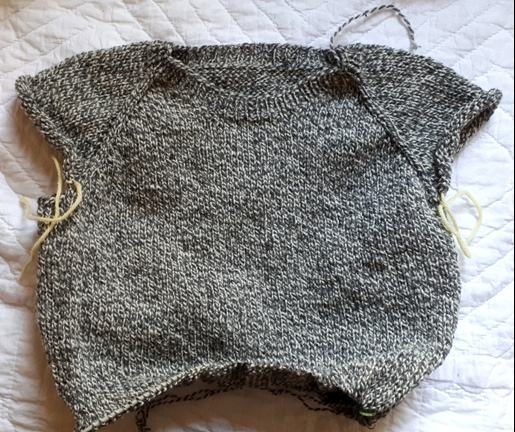
But of course, I am not doing this pullover like that. As my husband would say, “Have you met me?”.

I am starting with the neckband already knit in the round and to form the crewneck front, I’m going to work short rows. Why? Because I love short rows and they work.

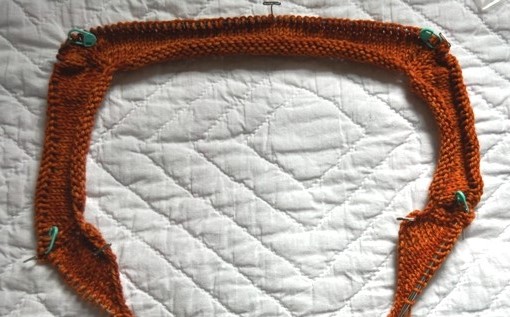
Look at that. To me it’s a thing of beauty. I know, it’s a weird designer thing. But I do love looking at this stage in my pullover. The Back is raised. The Front is lowered. And now we’re working in the round for the rest of the yoke.

Now I have a question for you. Here it is with a colour change.

Is the angled edge of the Front with the short rows too messy?

Here’s a close up of both sides. Messy?

I don’t mind it at all but …

Would you like one round of grey knit before starting the short rows? Yes or No?

Thanks. I appreciate your opinion. Cheers, Deb

Family Crew Neck

Any Gauge and Gauge-Free patterns by Deb

Crewneck Pullover Beginnings

I’m working on one more pullover pattern (Family Crew Neck) before shawl knitting takes over. Summer seems to be more suited to shawls and I understand, snow withstanding, that summer is really on its way.

I have devised several construction systems over my years designing Cabin Fever patterns. These were based on formulas which were then decorated with stitch patterns.

Now I want to present them to you as basic patterns so that you can do the decorating part. I know you can do this. You’ve been knitting for some time so you know a couple stitch patterns that you love. These basic patterns are an ideal place to let them loose on the front, back or sleeves.

The Family Crew Neck Raglan is my next project. I’ve done two prototypes so far. The recipients are very happy with them.

I’ve started on one more so that I can add in all the little bits of advice on keeping track. I have two more on the go so lots to show you coming up.

It’s still cool here so perfect for sweater knitting outside. I hope you are enjoying spring.

Cheers, Deb

Any Gauge and Gauge-Free patterns by Deb

Mid-sweater Block

I’m knitting a sweater for my son-in-law (Family Crew Neck) at his request. I was so very pleased to be asked. I have measurements and am ready to go. But this has turned out to be a challenge.

I’m trying out a new-to-me yarn and to be a good little knitter, I knit a swatch. I changed needle sizes twice and now have gauge. I even washed it. Pat on the back, I am being very, very good! I cast on.

Part way through I started to panic. It’s small. I did all the math again and then three more times and as far as I could tell the body is around 2″ smaller than it should be. I kept measuring it over and over, hoping it would be a little bigger each time. Ha, ha, I bet you’ve never done this.

Then the light bulb went on. I have a swatch. I find them somewhat unreliable at the best of times but this time I had one to blame. I measured my gauge on it and then on my sweater and … I had tightened up. This never happens to me. I am a really loose knitter. I was working with needles 2 sizes smaller than recommended to get gauge on my swatch and now I was telling myself that that was a mistake.

Hmmm, I washed my swatch just like I’m supposed to. Ah, ha. Another light bulb moment.

I dumped the whole sweater in the sink, needles attached and all, spun it out in my washing machine and laid it out (nice and neatly, not like this photo) and let it dry.

Voila, it relaxed and although it’s still 1/2″ smaller than I would like, it’s going to be fine. Phew.

I’m on the sleeves right now. I took out 1 round of knitting and started with new yarn. Here’s the difference in gauge. You can see that already the new section of the sleeve has a tighter gauge. I’m trying not to look at it.

Ignore the marker. That was for counting rounds so the sleeve stripe will be the same length as the body stripe.

I’m hoping to get this done this week. I don’t know if that’s possible but I’m giving it my best shot. Audio books, short walks and lots of knitting.

Cheers, Deb

Family Crew Neck raglan pullover

Any Gauge and Gauge-Free patterns by Deb

Gradient done 2×2

My gradient vest is coming along. Not famously but, well, you can see for yourself.

I think it’s an improvement on the original (below on the right).

I’ve tried to make the lines between the colours less distinct. I think I failed. There are still lots of horizonal lines going on.

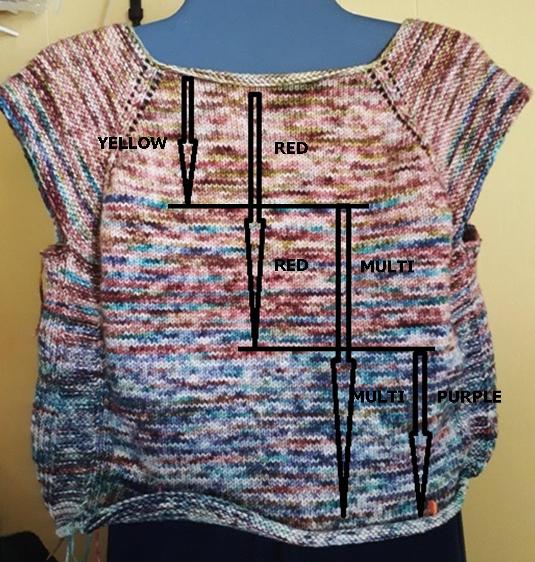
This is my range of colours. Starting with yellow through red, multi-coloured, purple and into blue and then green (if I get that far).

I’m using two colours all the time. Two rounds in one colour and two rounds in a second colour.

Each colour is worked with a second colour for approximately half a ball.

It goes like this:

Yellow & Red

Red & Multi-coloured

Multi-coloured & Purple

Purple & Blue

It hasn’t turned out as I expected. That’s not new. I’m carrying on anyway just to see how it turns out.

Cheers, Deb

Gauge-Free and Any Gauge patterns by Deb

Deb on instagram

I’m Stalled. Solution? Take something apart.

Here is a vest that I don’t wear. It fits great. I like the wool and the style. There’s just one little thing that bugs me.

That yellow band across my bust. I know, I know, it’s stupid to be self-conscious but … I am and I can’t talk myself out of it. So there it sits on the shelf, unworn, through no fault of its own.

The rainbow of colours that Dragonstrings dyed for me are terrific. So what’s a knitter to do?! Give it a tug, of course and … recycle it.

Now to figure out how to graduate the colours. Once gradient sweaters are knit the whole system seems so straight forward but I find it rather daunting. I scrounged around my stash and added one more skein to the mix of colours because more has to be better, right? The bottom multi-coloured skein is the addition and hopefully will work to help me graduate the colours.

The original vest sequence was: starting at the top, Red, Yellow, Green, Blue and into the Purple at the bottom.

This time, I’m going to reverse the circle direction.

New sequence: Yellow at the top, Red, multi-coloured, purple, blue, green.

OK, decision made. It’s in writing and I just told you all about it so here goes.

Have you done a gradient? Did it turn out like you thought it would?

Cheers, Deb

Gauge-Free and Any Gauge patterns by Deb

Deb on instagram

Two Sleeves on 2 circs

I ran across an idea, from Socks Soar on Two Circulars by Cat Bordhi, where she knits a sock on two circular needles instead of many double pointed needles. If you can knit one sock, why not two socks? So I tried it. I found it easier than I thought it might be and better for me than using the Magic Loop technique.

I put a photo up on instagram and my friend Nancy mentioned that she knits 2 sleeves at the same time. I was knitting away on my newest top down sweater and thinking, two sleeves at the same time, two sleeves at the same time. Wait one friggin’ minute. Could I knit 2 sleeves at the same time on a Top Down sweater? I just happen to have one with 2 sleeves to knit so …

… there they are. Two sleeves being knit at the same time, on 2 circular needles with 2 balls of wool. It took some fiddling to get them going. OK, it took more than a little bit of fiddling but there they are. I’m amazed. It’s not that hard. Really it wasn’t that bad.

They work a little bit differently than the socks did because there is a whole knitted sweater body there too. I had to move the beginning of the round to the middle so the body didn’t get too munched. The orange marker in the fabric of the left sleeve is there to indicate the beginning of the round for both the sleeves. It only matters for the decrease round.

I’m finding this quite satisfying to do. Here’s my progress so far.

You’ll see at the bottom there, that they are still on the two circs. When I’m working on the sleeves I use a safety pin to hold the sleeves close to each other but I wanted to see how they were looking. Not bad, eh?

Do you know that auto-correct does not like the word circ. It wants to make it all kinds of other things. Isn’t circ a word? It is to me.

Stay safe and keep on keeping on, Deb

Any Gauge and Gauge-Free patterns by Deb

Deb on instagram because you know there has to be more knitting going on.