What If … Diamonds

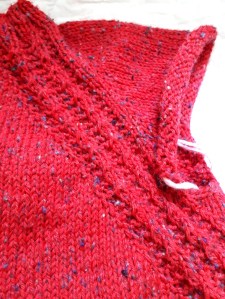
On your next raglan which you don’t want to be a raglan, you could try this:20180311_162222

Yes, you could.

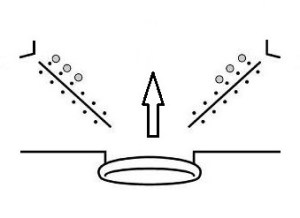
I’ve written a new pattern based on this idea called Kid’s Diamond Pullover where I moved the markers from the standard raglan set up to new positions. I still worked the same number of increases every other round. Moving the markers changes the shape of the neckline and this set up will give you a slight V in the front and back of the neckline with no trouble at all.

Here is the standard raglan set up with 4 markers for the raglan lines and increases worked on either side of these markers. The 4 markers are set between the sections of this sweater: Front, marker, sleeve, marker, Back, marker, sleeve, marker, second Front.skew 20180408_091840

So what would happen if we just placed the 4 markers equidistant from each other in a pullover? There are still the same 4 markers where you will work a pair of increases every other round. The stitch numbers will work out the same. It’s actually not too much of a leap is it?

Continue reading “What If … Diamonds”

What if … Skew stumbling

Sometimes an idea comes into your head fully formed and all that is needed is execution. It could be a variation on a recipe, a knitting pattern, a paint colour scheme, a new way to wear an outfit, an idea for your garden or something totally other. And sometimes upon execution, as hiccups develop, comes the realization that the idea was not as fully formed as you thought. Do you give up? Do you persevere?

This is happening with my Skew design and I am persevering because I am still excited about the original idea.

I started with the idea of moving one of the raglan increases over and working a stitch pattern into the space.skew 20180408_091905

My first little sweater had some problems. The ribbed stitch pattern was causing the front to pull against the buttonband. It would have to be buttoned up all the time to keep the front edges lined up.20180408_083659

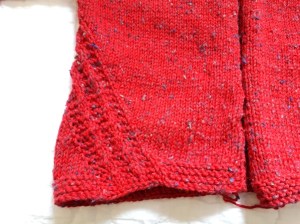
So I changed the ribbing to a broken rib (garter stitches between the twisted cables). Then I realized that the cable pattern had to be more prominent to stand up against the garter stitches. So that got changed too. A couple of hitches fixed up to my satisfaction.20180424_111308

I’m happy with the original idea of the skew which is showing nicely at the bottom of the front.20180424_111411

Almost there. This sweater needs a lighter colour to show the pattern well for photography so the next sweater will be light blue, pink, cream, oatmeal?? That’s my project this week.

I hope all your hiccups are minor and easily solved. Happy knitting this week,

Deb

ANY GAUGE and GAUGE-FREE patterns by Deb

Cabin Fever patterns

Deb on instagram


What Would Happen If …

Have you knit several Top Down Raglans? Are you looking at knitting another one and wonder if there is a small change you could make that would make it new again? I was thinking the same thought.20180408_083659

Continue reading “What Would Happen If …”

Raglan Increases 5 ways

There are so many ways to work every possible technique in knitting that you could, if you are adventurous, view a knitting pattern as a guide rather than written in stone. The ability to substitute different techniques to get a slightly different look means that many more patterns are available for you to use to get the exact garment you had in mind. This also, by the way, could save you quite a bit of time when choosing patterns.

If you are knitting a raglan pullover or cardigan here are 5 ways to work the increases that make the distinctive raglan lines. Do you want decorative holes, small holes or no holes at all? Keep in mind that an increase that is easy for you to work also makes the sweater a happier knit.

Continue reading “Raglan Increases 5 ways”

Knit to Fit: 7 Reasons to Double Up the Increases for Bust Shaping

One of the easiest ways to work some extra width on the front of your Top Down Raglan sweater is to work an extra increase beside the regular Raglan increase on both sides of the Front. In the last couple of inches at the bottom of the yoke you can work the EASY BUST SHAPING .Bust shaping Yoke increases Body schematic working EASY

You can add up to about 3″/8cm to the Front this way. Bust shaping Yoke increases Body schematic direction of knitting

I was asked if there were specific circumstances where you would use this method.

  1.  It’s a very straight forward way to add width to the front of your sweater without affecting the upper yoke and neckline.
  2. It’s easy to add these extra increases into any Top Down Raglan sweater pattern that doesn’t have extra width already written in.
  3. A couple of extra inches on the front really helps to alleviate button gap on your cardigan. If you wear your cardigans buttoned up, positive ease at the bust is a necessity. I cringe every time I see button gaping on a cardigan in a magazine.
  4. Nothing shows. No one can see the extra increases since they are almost in your armpit.
  5. Working the increases above the underarm works really well for a bust that is high. More traditional bust darts may be too low when they begin below the underarm.
  6. One of the best reasons is for the well endowed. The Doubling Up of Increases method can be used in conjunction with more traditional styles of bust darts. A couple of inches added at the bottom of the yoke (just above the underarm) plus bust darts in the bust area itself can add 4-6″ extra width at the bust if needed.
  7. If you have a stitch pattern on your sweater, bust darts may interfere. This method can be added where you are already working the raglan lines so they are less likely to interfere.

Could you do a little bust shaping on your next Top Down using the Easy Bust Shaping method?

Thanks for reading,

Deb

ANY GAUGE and GAUGE-FREE patterns by Deb

Cabin Fever No-Sew patterns

Deb on instagram