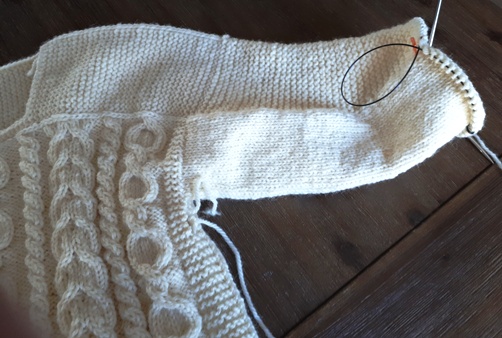
What is this phrase? Do you know where it came from? I have no idea. That’s where I am though, on sleeve island.
I started the sleeve for my own Saddle Up, even though the body isn’t finished. I have one ball of wool attached to the sleeve and another ball still attached to the body.
It makes it look more like a real sweater, don’t you think? That’s what the sleeves can do, I guess.
I think the other sleeve will need work before I go back to cabling the body. Then I’ll be more than ready to get it finished. I do find getting to the finish line a little bit difficult.
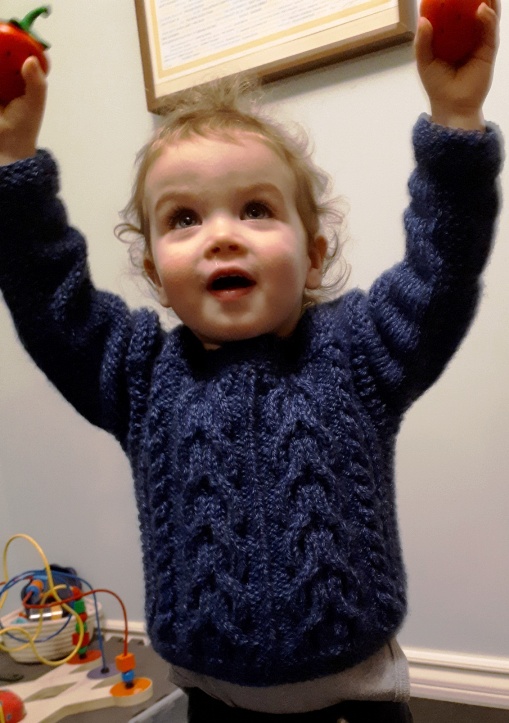
But look – I did finish a Saddle Up sweater for my favourite little guy. Yahoo.
It’s quite possible that knitting three cable sweaters at the same time was not the most brilliant idea I have ever had. Ya think?!
I’ve taken a couple of days off from the Saddle Up pullover. I am knitting a sock, in the basic cuff-down traditional style …
… and some of Cat Bordhi’s Family of Fingerless Mitts, worked in garter stitch. This is not mindless garter stitch – Cat Bordhi didn’t do mindless – but they did take my brain somewhere else. It helped to settle me down.
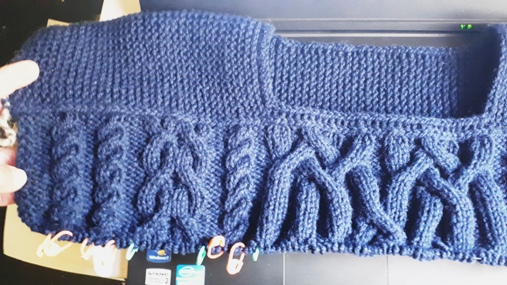
I’ve joined this Saddle Up in the round. It’s for my son and I should probably try this on him. I may have to work some decreases for his hips. Definitely not what I have to do for my own pullover, sigh.
This is my pullover, also joined in the round now. You may notice that it is not as far along as my other two. What’s that all about?!
There is also nothing wrong with knitting this Saddle Up sweater flat. This is a little 2 year size. Knitting the sleeves means the finish line is close. All the edges are in garter stitch so it will be easy to sew up the sides.
I’m afraid there is no Christmas knitting going on here. How about you? What are you up to?
A drop shoulder pullover can be knit in a combination of knit-in-the-round and knit flat, whether it’s knit from the top down or the bottom up. If you add cables to the pattern, like in the Saddle Up pullover, well, it gets a little trickier.
Cable patterns are almost always written to be worked flat, with a right side and a wrong side. The cable crossings are worked on the right side rows. This simplifies things a little bit. You know those right side rows are the ones to watch out for.
At some point, you may need to work in-the-round. Then, you have the right side facing you all the time. Figuring out when to cross cables can be a little more difficult.
Here is a 4-stitch cable, where two stitches are crossed over two stitches, every 4 rows. The lines in the photo indicate the outside stitch of this Left Cross. See that hole just to the left of the crossing stitches? That’s caused by the crossing. (On a right cross cable, the hole would be on the right of the cable.)
When this cable is worked flat, there is a Right Side Row where you worked the cable cross, followed by a wrong side row, right side row and one more wrong side row. On the next Right Side row you would work a new cable cross.
When you work in-the-round you only have the Right Side facing you. Then you have Round 1 where you cross the cable, followed by Rounds 2, 3 & 4. Then cross again.
If you put something straight into the hole created by the crossing and run it under the horizontal bars to the needle, you should see the 4 bars. I used a sewing up needle but your cable needle may be handy and it would work great.
When you can count 4 bars, you are ready to cross again on the next round. If you have a 6 stitch cable, crossing every 8 rows/rounds, you would work until you can count 8 bars from the hole created by the last crossing. It works.
Have you tried this? I don’t use a cable needle. I was going to say I don’t own one but I think I do. It’s in the container with my set of straight needles which I also don’t use. Why do I still have them? That’s a very good question. Let’s not go there today.
One of my internet friends wanted to know how I get my cables to look so neat and tidy. My first thought was that I had no idea. I just do them and they turn out that way. But then, the next day, I remembered that I don’t use a cable needle. It’s not that I didn’t know I don’t use a cable needle, that would be sort of crazy, it’s that I haven’t used one for quite a long time so it doesn’t occur to me that they are needed to work cables.
So I did a video to show you how I do it. Thanks CD for the question that prompted this. I hope this visualization helps.
Only use the tips of your needles. Push all the stitches on your needles to the tips so you can maneuver your needles without pulling any of the stitches.
Take your needles to the stitches. Load the stitches going to the Back first. Once they are on your needle, Leave Them Where They Lie, usually slightly to the back of your work. Don’t move them because they will pull the stitches that are still hanging free.
Load the stitches going to the Front.
Cross the stitches to the Right or Left and load the stitches on your right needle onto the left needle. Check that you crossed them correctly. If not take them off and start again.
Knit across the cable stitches.
It’s a little risky but so satisfying and no cable needle to lose, imagine that!
Designing your own garment? Maybe you are working on the Saddle Up pullover with me and it’s time to work the cables. Here’s what you need to know.
Cables pull your fabric in as soon as the first cable is crossed. You have to make sure you accommodate for this fact or … well, your sweater or project will be much smaller than you had anticipated.
Let’s say you want to work a 4-stitch Rope Cable (worked by crossing 2 stitches over 2 stitches). This cable is worked in stockinette stitch and is a pretty common cable to work.
Once you start crossing this cable, it is no longer the width of 4 stitches. It is closer to the width of 3 stockinette stitches.
If you have a sweater where you want to introduce a 4-stitch Rope Cable, set it up for 3 stockinette stitches to begin with. Then increase 1 stitch before you work the first cross. That’s it.
A basic rule of thumb: for every 3 stitches of the cable, set up 1 less stitch. Add them back in by working increases before the first cross.
Here’s another example: 6-stitch Rope Cable where you will cross 3 stitches over 3 stitches – set up 4 sts and before the first cross, increase 2 stitches (now you have 6 sts for the cable).
This is fairly straightforward, except … (you knew this was coming, right?), the more complex the cable, the harder it is to do this successfully. Do I have to say the S word? Yeah, I do. You have to swatch!
Elizabeth Zimmermann had some great advice. Her suggestion was to cast on 96 stitches and knit a hat with all the cables. It will fit someone.
That can work as your swatch. Measure across the cable once you have worked the cross several times. Use your stockinette stitch gauge to figure out how wide the cable is in stockinette stitches. That is the number of stitches to set up and how many stitches you need to increase before the first crossing.
Example: Let’s say you have a 12 stitch complex cable, repeated several times on your hat, measuring 1.75″ across. Your stockinette gauge is 20 sts = 4″ OR 5 sts = 1″. 1.75″ x 5 sts = 8.75 sts, rounded up to 9 sts. Set Up the cable with 9 stitches and increase 3 stitches in the first row to 12 stitches and cable away.
Norah Gaughan has coined the phrase SSE: Stockinette Stitch Equivalent. The SSE for the complex cable above is 9 sts, even though the chart for the cable is 12 sts wide. Yeah, I know, this can mess with your head.
I would like to recommend her book, Knitted Cable Sourcebook for this information. There are tons of cables in this book and they all have an SSE. She’s done it for you. No swatching necessary. I don’t receive anything if you buy this book. I’m so happy I bought it. You might know that I am not a happy swatcher.
The latest section of the Saddle Up pattern is in your ravelry library. Update the pattern and set up your cables. Have fun.
While I was walking this last week, I had an idea. It just shows that walking can be hazardous to your blog.
I was strolling along, wondering what I would talk about on this blog post, well not really wondering, because it was going to be about cables, but there seems to be a problem. Cables aren’t the problem. The problem is I’m always going to rattle on about what I’m knitting at the moment. Since I’m designing and writing the pattern as I progress, that’s what you’re reading about.
That’s not going to stop. I almost always have some new idea on the needles in my hands. Right now it’s a drop shoulder, top down pullover with cables. This is my first prototype, for my son.
What I find frustrating is the delay between designing something and the pattern publication date. Maybe you find this too. I go on and on for months about a sweater I’m knitting. Then the pattern goes to test knitters and needs photographs and edits. Procrastination kicks in just about here, especially around photos. It won’t come out for several months after I’m done talking about it and definitely onto something new.
So, here goes. This is the idea. I will publish the pattern in stages. I’ll post the beginning of the pattern on ravelry for a small fee. We can call it a Knit-A-Long, sort of like a mystery sweater. I’ll talk about some aspect of it on the blog every week and send you an pattern update every week or so. We can knit the sweater together. This gives me the chance to write my blog as if I was teaching a class where I give you the instructions one page at a time over several weeks. I can tell you so much more about techniques and sizing in the blog than I can in a pattern.
The pattern is the Family Saddle Up pullover with cables. All sizes from 1 year old to large adult in any yarn (my suggestion would be for worsted, heavy worsted/aran weight or chunky weight yarn). The pullover will knit top down with saddle shoulders and drop sleeves. The saddle shoulders and the yoke will be knit flat to the bottom of the armholes, then joined in the round to the bottom. We’ll pick up the sleeves and knit down to the wrists.
I’ve cast on for a second sweater so I’m ready to go.
I’ll knit both the navy and white pullovers as we go along. While I’m at it, I’ll probably do a 2 year old size because I have a little guy to knit for.
I’m going to start next week. If you’ve got some sweater yarn and some free time, I hope you’ll join me. Stay tuned.
How do you choose cables that go together on a sweater when the choice is yours? It’s not so hard. Here is how I get started. Maybe this will be helpful to you.
I am knitting a Top Down, drop shoulder sweater. Beware, any pattern in a stitch dictionary is meant to be knit bottom up. If knitting Top Down, turn the book upside down when you’re looking at the photos because that’s what they will look like when they are knit. If you do this on the subway you may get some interesting looks.
I chose two different centre patterns that were both 32 rows deep.
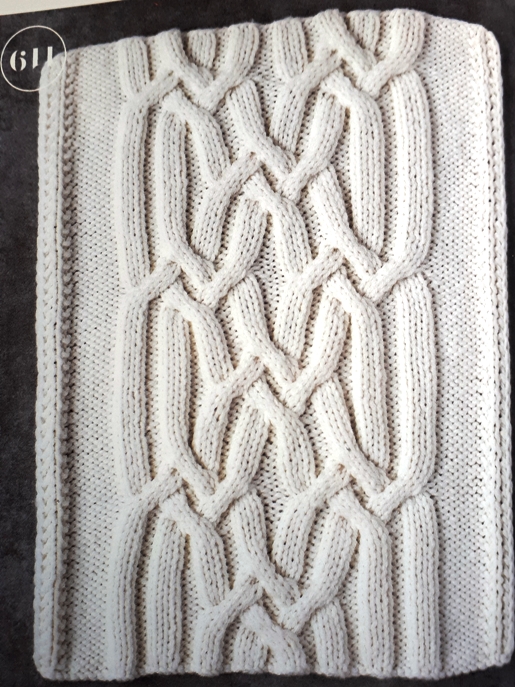
On the left is Tangled Ropes, pg.80 in Charted Knitting Designs, A Third Treasury of Knitting Patterns by Barbara G. Walker. On the right is #119 Crosshatch Bias from Knitted Cable Sourcebook by Norah Gaughan.
Now I chart them. This is swatching with a pencil. Even if they are charted in the stitch dictionary I do it again.
Is it hard to chart?
I love the Tangled Ropes but … I wore out an eraser charting this.
I found it hard to chart and I think it would be a little too complicated to knit for this project.
Look at this one, the Crosshatch Bias. Even though there are many cable crossings, they all cross the same way on each line. It doesn’t get any better than this.
OK, decision made. The centre pattern is settled. I’ve started knitting and it looks complicated even though it’s quite straight forward to knit. Gotta love that.
Then do the same for some side patterns. This time I need them to work with the 32 rows of the centre pattern, meaning that the repeats of the side patterns must add up to 32 rows.
I want one more wide pattern and found a couple I liked. One that was 8 rows deep and a second one that was 16 rows. I’m going with this one.
Then I need a small pattern to take up some space. A 4 stitch cable worked over 4 rows goes into 32 rows quite nicely.
Next, setting them up. Yes, still some work to do before the knitting can start.
If you can’t think of anything else to do, start a new project. That’s a good motto, don’t you think? I’m trying to convince myself to sew in the ends of the two V-Neck Cardigans I have finished. And that’s the trouble, right there. I think they’re finished. They are not. They require some after-knitting care and I struggle to do this with every single project I do. Every. Single. Project.
So of course, I started something new. A new sweater. It’s an idea I’ve been thinking about: a saddle shoulder, drop sleeve pullover with cables. Worked from the top down, of course.
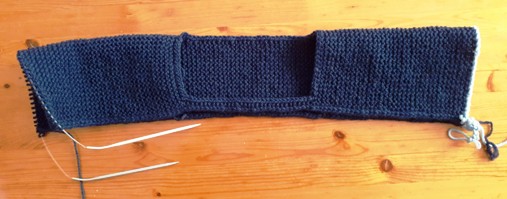
So here we go. I started with a provisional cast on for an 8″ saddle which will be 4″deep on the front and 4″ deep on the back. I worked the shoulder in garter stitch to the width I wanted to the neck opening edge. Then I put the Front Stitches on hold and knit across the Back of Neck first.
Next I worked a small number of stitches for the bottom of the Front neck opening. This is going to give me a 3″ deep neck opening. I will pick up for the neckband later. Then I cast on for the other side of the neck opening and knit the other shoulder.
When it’s folded at the top of the shoulder it will work like this.
I hope this works because I’m quite captivated by this idea. Cables are coming up next. What do you think?
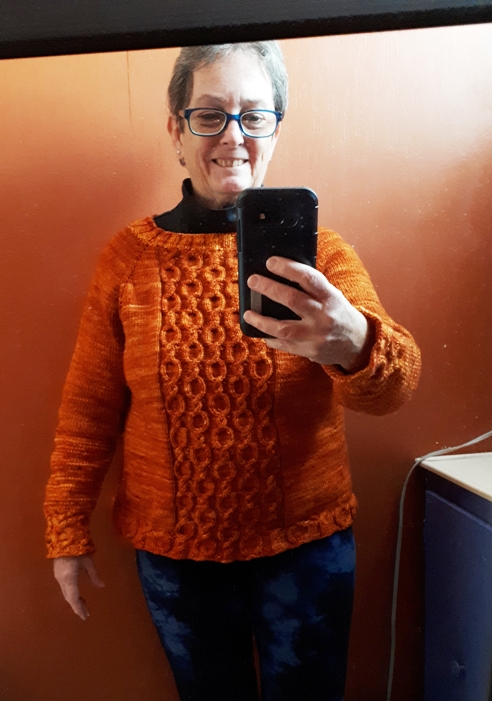
It’s done. Phew. My newest Any Gauge Raglan Pullover was made by taking apart a sweater I wasn’t wearing and turning it into this one. I put it on the day I finished, and the next day, and the one after that. I think I like it. Here’s the requisite bathroom photo.
I don’t know if you can see but I ran out of wool. Yup. I knit this pullover with a much smaller needle than the original sweater. Ouch, just one ball short. So into the stash I went.
I found one ball of orange (on the left) and yes, it doesn’t quite match but … what can you do?!
I got the bottom of the sleeves and the neckband out of it. It’s not perfect but I’m really happy with it. I keep wearing it. That’s the real test. It passed.
Now a pause. I find there is always a very uncomfortable pause after finishing a big project. Do you find that?
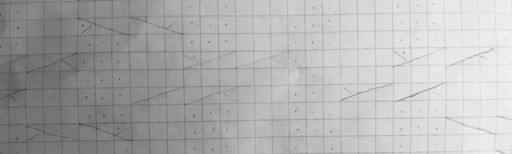
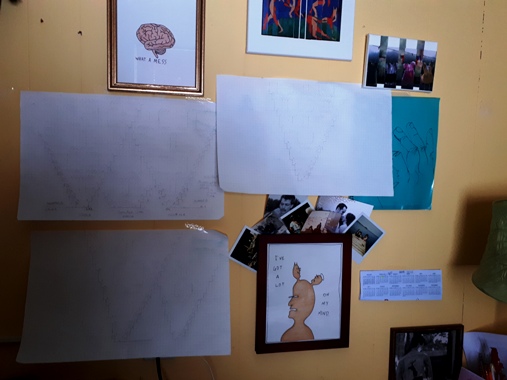
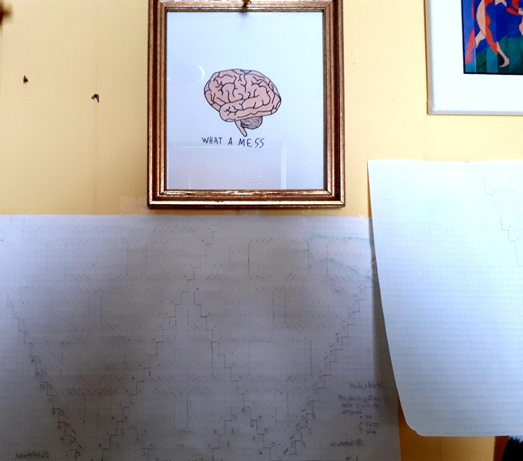
I started doodling, otherwise known as charting. And then it got out of hand.
I’m not going to apologize. I love charts!! I think most knitters need to learn how to read them and use them. Once you can do that, a whole world of modification is open to you. Charts can be played with. Charts can be changed to suit you and your project.
I’m knitting the Any Gauge Raglan Pullover. One of the great things about this top down pattern is that it has a wide Front and Back neck opening. This gives you lots of room to place a pattern. In this one I put a large cable down the front and back (the cable is included as a variation in the pattern).
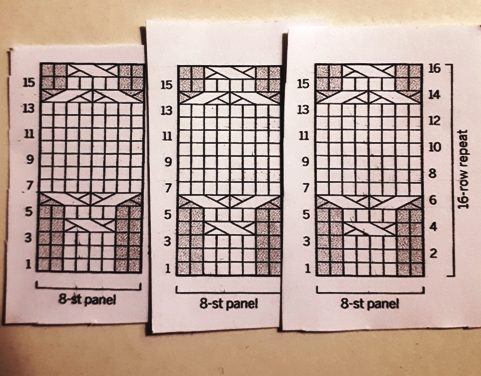
This time I wanted to work a wider panel of cables down the front and back. This is the pattern I started with. Cable #15 out of the Knitted Cable Sourcebook by Norah Gaughan. An excellent book.
To figure out how I might work multiple strands of cabling, I photocopied the chart to see what I could do with it.
I could do several strands of the same cable.
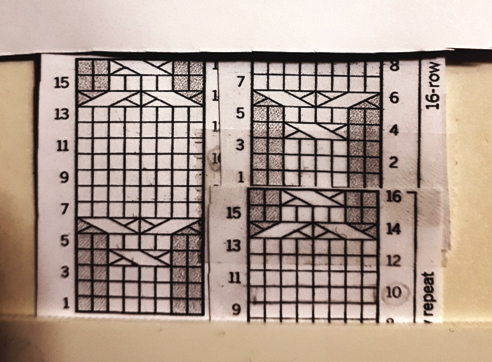
But then I thought it would be more effective if I off-set them somehow. First I had to find the centre of the round circle of the cable and the centre of the little straight section. Row 10 is the centre row of the 7 rows in the round circle and Row 2 is the centre of the 3 rows between the small crosses.
Now to line the centres up.
Oh my, this is perfect. Look at that. The big cable crosses of the circles on both strands line up. On the right cable Row 6 opening the circle and on the left cable Row 14 closing the circle. This is totally going to work.
Here’s my pattern. I’ll repeat these two cables twice and work the Right cable once more for 5 cable strands. Odd numbers rule in this case. Throw in a couple of purl stitches at the beginning, between each cable and at the end and I have a terrific cable panel.
Charts, are they the coolest or what?!
Stay safe. We’re in the covid Red zone as of today so lots of time to sit at home and knit.















 Deb Gemmell: Top Down, Gauge Free and more