Cable pullover done

It’s done. Phew. My newest Any Gauge Raglan Pullover was made by taking apart a sweater I wasn’t wearing and turning it into this one. I put it on the day I finished, and the next day, and the one after that. I think I like it. Here’s the requisite bathroom photo.

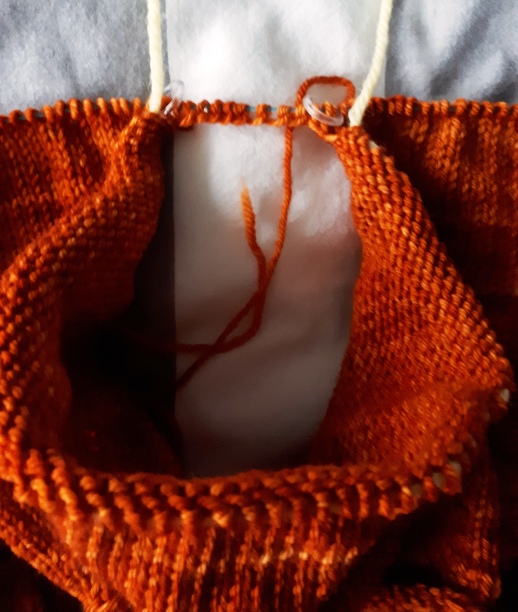
I don’t know if you can see but I ran out of wool. Yup. I knit this pullover with a much smaller needle than the original sweater. Ouch, just one ball short. So into the stash I went.

I found one ball of orange (on the left) and yes, it doesn’t quite match but … what can you do?!

I got the bottom of the sleeves and the neckband out of it. It’s not perfect but I’m really happy with it. I keep wearing it. That’s the real test. It passed.

Now a pause. I find there is always a very uncomfortable pause after finishing a big project. Do you find that?

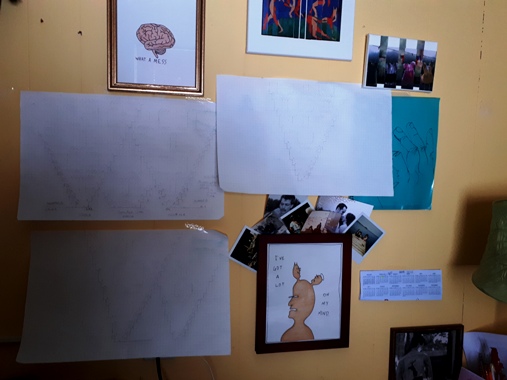
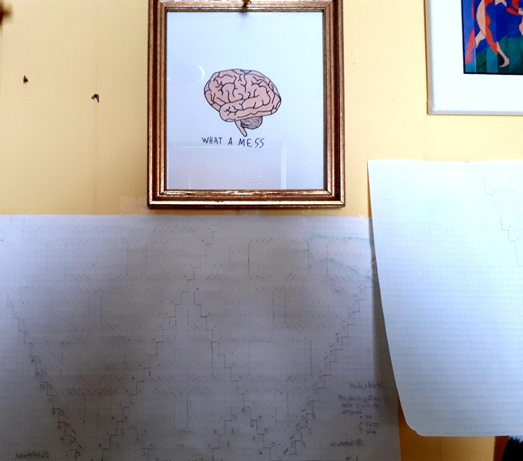
I started doodling, otherwise known as charting. And then it got out of hand.

Time to do a clean up I guess.

That’s better but I still have a lot on my mind.

How about you?

Deb

Any Gauge and Gauge-Free patterns by Deb

Deb on instagram because you know there’s more knitting going on.

Bust Darts, Top Down

Why are the fronts of women’s sweaters the same width as the back? Aren’t there two very good reasons why there should be a little more room on the front? You could work two different sizes to fix this but it needs quite a bit of fiddling to get it right. There is an easier way.

You need the extra room exactly where you need it, right? You know where. Not in the upper chest and neckline which could happen if you work two different sizes. Not below the bust either.

Here’s one of my solutions. I used on my latest Any Gauge Raglan Pullover. When working Top Down you can add an extra set of stitches to the Front of the Body starting just under the arm, after the Great Divide.

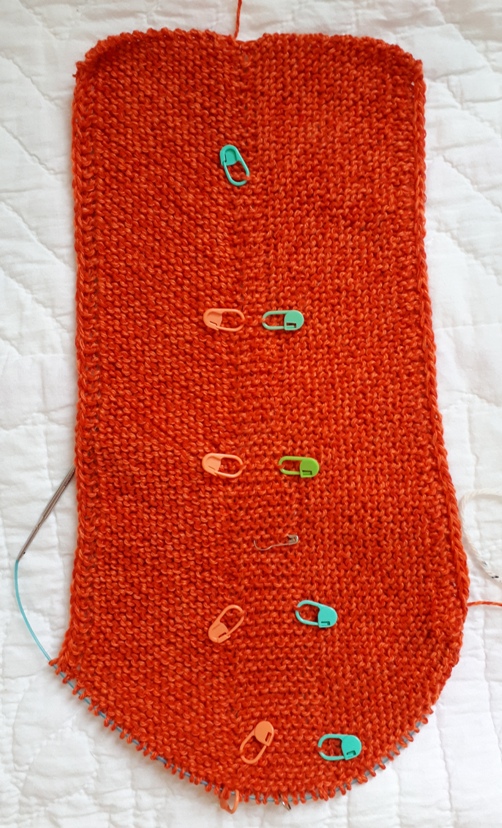
Can you see a faint line coming out of my underarm at an angle? Here, let me highlight it.

It’s not very visible. The increases are worked on every round. Each increase is worked beside the last one, working from the underarm toward the centre of the front. I added 6 extra bust stitches on each side of the Front, worked the rounds straight down past the largest part of my bust and then began working decreases at the sides of the Front every 4 rounds to get rid of some of these stitches (not all of them because, with Covid, the belly is a little larger than before!!).

I used Twin Stitches. They are the stitches used in the Shadow Short Row system which, if you don’t get rid of the double stitches (the twin stitches) as you would when working short rows, these twin stitches can become increases. It’s magic.

Here’s my video to show you how: Bust Dart for Top Down Pullover using TWK

This is how you work a Twin Stitch. If you’ve been following me for any amount of time, you’ve seen this before. I discovered this while working on the Need A Circular Yoke book. Have you tried this?

Stay safe and keep on keeping on, Deb

Any Gauge and Gauge-Free patterns by Deb

Deb on instagram, because you know there’s more knitting going on.

Ease for a Top Down Raglan

Ease is really personal. Ease is the amount the finished sweater is bigger or smaller than the measurement at your bust line. How tight or loose you wear your clothes across the bust, is entirely up to you. Two people with the same bust measurement may knit two different sizes, depending on how they want their sweater to fit.

Positive ease means the sweater is bigger than your Actual Bust Measurement. A sweater that measures 44″ around on a body with a bust measurement of 40″ has 4″ of positive ease.

You can have negative ease too. If the sweater measures 38″ around the chest on a body with a bust measurement of 40″ then the sweater is said to have 2″ of negative ease. The T-shirts you wear usually have negative ease. It does not mean it’s 2″ smaller everywhere. If the sweater is knit straight it may have positive ease on the torso even if it has negative ease at the bust line. Apparently, in the knitting industry, we are only concerned with the fit at the bust line. Go figure (pun intended).

For the Any Gauge Raglan Pullover I was attempting to fit a pullover with some positive ease. At the Bottom of the Yoke this sweater would fit like a second skin. It fits your Actual Bust Measurement + both your Actual Arm Measurements. It fits your body exactly as measured. But we don’t leave it there.

In this pattern I have you add the Ease as a cast on at each underarm.

How much ease? That’s up to you. The easiest way to determine how much is to measure the sweaters you wear. How much bigger/smaller is your favourite sweater than your Actual Bust Measurement? That’s the amount of ease you like. Half the ease is added as cast on stitches at one underarm and the other half, cast on at the other underarm. Now your sweater body has the amount of ease you wanted.

You can see that half the Body Ease will eventually also be added to the sleeve. Let’s say you want 3″ of ease for your body, then 1.5″ is cast on at each underarm. When you work your sleeve, you pick up one stitch for each underarm cast on stitch, so adding 1.5″ of ease to the sleeve.

But … you knew this was coming, there are modifications you can make here.

  1. Different ease for your sleeve: If half the Body Ease is not the right amount of ease for your sleeve, as you set up your sleeve you can pick up additional stitches in the corners beside the cast on stitches for slightly more sleeve room or for less ease, pick up fewer stitches from the cast on stitches. It won’t involve very many stitches + or – so is fairly easy to do.
  2. You miscalculated your gauge: Your pullover at this point is a little smaller than anticipated. You can cast on additional stitches to add body width plus the amount of ease you wanted, as you cast on at each underarm. If your sweater is too big at this point, sorry you’re going to have to rip back several rounds before you cast on for the underarms.
  3. Yoke is getting too long: Your pullover yoke is already level with your underarm so you don’t want to work any more increase rounds to get to your total number of stitches at the bottom of the yoke. You can cast on the extra Body stitches needed to get to the correct number of stitches at the Bottom of the Yoke at the underarms (divided between the two underarms) along with the amount of ease you want.
  4. You want Negative Ease: Work until at the Bottom of the Yoke your sweater is the number of inches of negative ease you want plus extra 1″ smaller. Then cast on 1/2″ worth of stitches at each underarm. For example, if you want 2″ of negative ease then knit until your Yoke is 3″ smaller than your Actual Bust Measurement (2″ negative ease + 1″ smaller). Cast On 1/2″ worth of stitches at each underarm. This will make your sweater come out to the amount of negative ease you wish plus add a little ease to your sleeves.
  5. Extra Bust Width: You want to add some extra width to the Front only. Take your Total Sweater Ease at the Bust – Ease added on the Front only = cast on the underarms, divided between the two underarms. For example: Total Sweater Ease at bust is 5″ – 2″ added to the Front only = 3″ ease to Body at the underarm (1.5″ cast on at each underarm).

You might guess what I did. Give up? Yes, I added extra ease across the Front only. We’ll get into that next.

Cheers and stay safe and well, Deb

Any Gauge and Gauge-Free patterns by Deb

Deb on instagram for all my other knitting

Cabled Cuffs

Sometimes it’s best to let your knitting do what it’s best at. That’s what I did with my cuffs.

Cables pull in the fabric. More than you might think. When you add cables into a sweater you need to compensate for this. At the top of my Any Gauge Raglan Pullover sweater I increased 2 stitches for every cable column: 5 columns, 10 stitches increased. I was told a rule at one time which said to increase 1 stitch for every 3 stitches of the cable. These are 8 stitch cables so a 2 (or 3) stitch increase seemed about right.

For the tight cuffs, why not just let the cables do their thing? I worked 5 cables around the cuff with the same needle I used for the sleeve. So, here it is with the same needle, same number of stitches as at the end of the sleeve. The cables pulled my cuff in quite a lot. Sometimes what the knitting wants to do is the way to go.

Apparently it’s time to reboot. My phone earphones wouldn’t work today. Reboot. My computer wouldn’t show any of my typing. Reboot. Now I just need to finish rebooting myself. I’m not quite there yet.

I think the week between Christmas and New Years is that time. I read 5 books. Knit a little less. I baked bread and cookies, my two essential life-giving foods. Have you rebooted yet? Are you ready for 2021?

Cheers, Deb

Any Gauge and Gauge-Free patterns by Deb

Deb on instagram

Playing with a chart

I’m not going to apologize. I love charts!! I think most knitters need to learn how to read them and use them. Once you can do that, a whole world of modification is open to you. Charts can be played with. Charts can be changed to suit you and your project.

I’m knitting the Any Gauge Raglan Pullover. One of the great things about this top down pattern is that it has a wide Front and Back neck opening. This gives you lots of room to place a pattern. In this one I put a large cable down the front and back (the cable is included as a variation in the pattern).

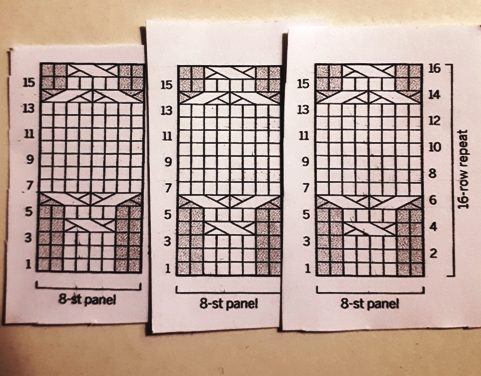
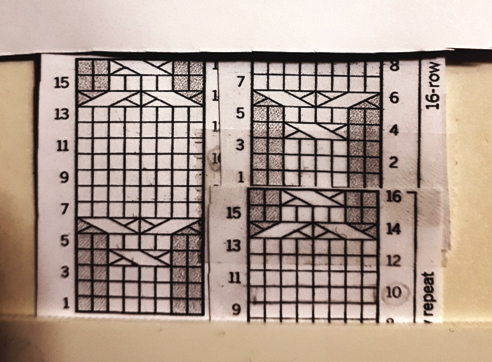
This time I wanted to work a wider panel of cables down the front and back. This is the pattern I started with. Cable #15 out of the Knitted Cable Sourcebook by Norah Gaughan. An excellent book.

To figure out how I might work multiple strands of cabling, I photocopied the chart to see what I could do with it.

I could do several strands of the same cable.

But then I thought it would be more effective if I off-set them somehow. First I had to find the centre of the round circle of the cable and the centre of the little straight section. Row 10 is the centre row of the 7 rows in the round circle and Row 2 is the centre of the 3 rows between the small crosses.

Now to line the centres up.

Oh my, this is perfect. Look at that. The big cable crosses of the circles on both strands line up. On the right cable Row 6 opening the circle and on the left cable Row 14 closing the circle. This is totally going to work.

Here’s my pattern. I’ll repeat these two cables twice and work the Right cable once more for 5 cable strands. Odd numbers rule in this case. Throw in a couple of purl stitches at the beginning, between each cable and at the end and I have a terrific cable panel.

Charts, are they the coolest or what?!

Stay safe. We’re in the covid Red zone as of today so lots of time to sit at home and knit.

Cheers, Deb

Any Gauge and Gauge-Free patterns by Deb

Deb on facebook

Deb on instagram

Raglan, No Pooling

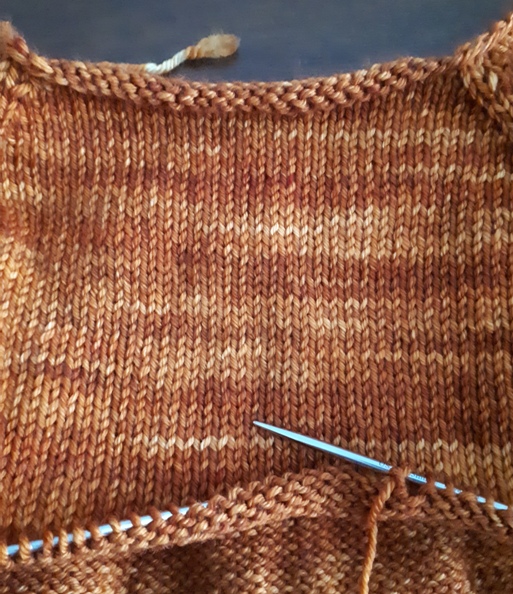
Here we go. I’ve taken apart a sweater I don’t wear, reconditioned the wool and now I’m going to get started on a new pullover. I hope to avoid colour pooling this time.

I’m working my Any Gauge Raglan Pullover pattern with a gauge of 5 sts = 1″. This wool has a lot of colour variation in every ball so … I’m going to knit it with 5 balls at the same time!!!

Yes, 5 balls, count ’em.

OK, OK, I didn’t start with 5. I started with one. I cast on all the stitches for the raglan neck opening with ball#1, placing markers as I went.

Then I got 3 more balls out and, working the raglan increases according to the pattern, I knit the Back with ball#1, knit the first shoulder with ball#2, knit the Front with ball#3, knit the second shoulder with ball#4. That takes me back to the beginning of the round. Each section of my raglan is knit with a different ball of wool and my first set of increases have been worked.

Here is where the Helix knitting (in this case, changing the yarn in the same place each time) comes into play. With one more ball, ball#5, I knit the Back to the marker, dropped that wool and slipped the marker. With the next ball, the wool that is sitting right there, I knit across the shoulder to the next marker. Dropped that wool and slipped the marker. Knit across the Front using the wool from the next ball that is sitting there. Slipped the marker and again with the wool that is sitting there, knit the second shoulder to the end of the round.

I know this sounds complicated but the wool you need to use is right there at each marker. You drop the wool you are knitting with, slip the marker and pick up the new wool and knit.

There is, of course, a TRICK. Do Not Twist the wool at each marker. When you approach a marker, take the wool strand you were just using and hold it to the right, slip the marker and pick up the new strand of wool from underneath. It’s not twisted.

Why bother with all this?

Two reasons. Because you don’t twist the wool when changing balls, there is no pull at the raglan lines where the markers are. It’s a smooth transition. Reason Two: THE BALLS DO NOT TANGLE.

How is this possible?

When you knit you are moving the yarn from the left needle to the right needle so the circle of knitting is moving clockwise. That twists the wool like this.

Every couple of rounds, grab your circle of knitting like a steering wheel and turn it counter-clockwise, like you’re making a left turn.

This really works!! I’m a little further along now. This is how the colour is coming out on my knit shoulder. An even distribution of uneven colour.

I’m pretty happy.

Cheers, Deb

Any Gauge and Gauge-Free patterns by Deb

Deb on instagram
Why don’t I wear this sweater?

Spring has sprung and it’s time to wash and then put away the heavy woollies. As I take out sweater after sweater, I wonder why certain ones never got worn. I liked it when I knit it. I like everything while I’m knitting. I thought at the time I would wear it.  Why didn’t I? Maybe it’s time to find out and do something about it.

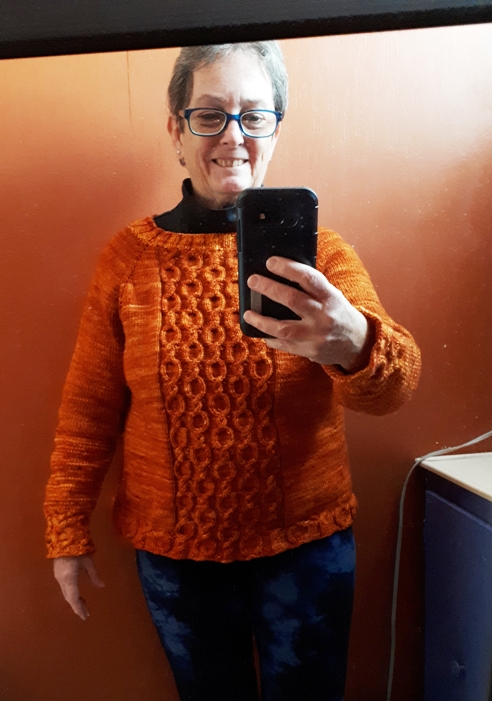
Here is one of my Gauge-Free Raglan Pullovers. This was one of the last ones I knit as a sample for the pattern and I took a couple of short cuts or at lease didn’t give it the time and consideration I could have. I pick it up and put it down a lot. I even get as far as putting it on and then take it off. Hmm, I wonder why? It’s time to find out.gauge-free raglan (2)

I like the woolly feel of it. I like the big cable down the front and back and the little cable down the sleeves. It was fun to knit. The fit is fine. It’s totally worth the time and effort to get right. Time to investigate. I put it on one more time. What’s bothering me?IMG_3898

  1. I think it would be more attractive if it was shorter. It feels heavy when it’s on so making it shorter would make it feel lighter.
  2. I think the neck opening looks too wide for me. I would like to fill it in more.
  3. I wish the neckband was raised at the back of neck. I can feel the edge of it lower down on the back of my neck than I would like. Making the neckband wider will help but I think I’ll do some short rows to raise the back of the neck this time.


I’m feeling better already. I have a plan. It starts with ripping. I know ripping can be painful but this is in a good cause and seems right.gauge-free raglan (3) Mods

  1.  Rip back to a shorter length. This is knit top down so all I have to do is snip one stitch of the cast off and start ripping until the length seems best and then re-knit the bottom ribbed edge.
  2. Rip out the neckband. Since it was picked up around the neck opening and cast off at the top edge of the neckband, I have another easy rip back.
  3. Use the yarn I took off the bottom of the sweater to reknit the neckband to deeper length with short rows to raise the back of the neck.

Now I’m getting excited. This is sooo going to work.

Do you have some sweaters you need to rework? Have you done this before?

Cheers, Deb

Gauge-Free and Any Gauge patterns by Deb

Cabin Fever No-Sew patterns


No Math and Gauge-freedom

Can you make a Gauge-free sweater Math-free too? No gauge swatch needed and no calculator?

What if throughout a sweater you only had8 to refer to one number, call this the primary number. Then you might need 2 times that number and then later, half that number. Does that count as doing math? You can do it in your head. No calculator needed.

I seem to be drawn to what I call Magic Numbers. It happens without me knowing it. When I wrote the Need A Hat book by Cabin Fever, it became clear, very quickly, that the entire book is based on the number 8. It’s one of my favourites. The idea for the book came when I was giving a talk about knitting hats. You take someone into a yarn store to choose yarn and they immediately go to a colour they love. Now you have to find a pattern for that yarn weight and size and with a style the recipient would like. What if we wrote a book where every hat could be worked in any weight of yarn? That got it started.

Now I’m working on this Gauge-Free cardigan idea, Build a V, without stitch gauge numbers in it at all.

The entire sweater is based on one number. That number is the number of Ridges it takes to make the Beginning Triangle for the Back of Neck measurement. It’s a different number for everyone.

build a V count R on triangle

I called this measurement D, for the only reason that it’s the 4th thing you do in the cardigan.

So now we have ‘D’ number of Ridges. For my little person cardigan in worsted weight yarn, ‘D’ = 6 Ridges. That number ‘6’ is going to be used over and over in the making of this sweater.

Make the Fronts ‘D’ number of ridges shorter than the Back. You got it, 6 Ridges shorter.

Publication1

That makes two more pieces of the puzzle that is this cardigan.

Build a V child blank schematic - shaded back panel and front panels

Now join it up to make a half a sweater. Pick up & knit along the sides of the Front. For the shoulder, which is going to link up the Front and Back, Cast On 2 x ‘D’ number of stitches. Pick up & knit along the Back. There it is again, that Magic Number: if ‘D’= 6 Ridges then 2 x ‘D’= 12 sts for the side of the neck opening.

Now knit for the width I want.

Publication2

Half the cardigan is done. YAY. Build a V cardigan is now published.

Thanks for reading,

Deb

Any Gauge and Gauge-Free patterns by Deb

Cabin Fever No-Sew patterns

Gauge-Free Back of Neck

The Back of Neck is an important measurement. I’m sure you know what your favourite Back of Neck width is, No? Go and measure some sweaters. I’ll wait here ….. well, what did you find?

I bet you found that you wear not one but several different neck styles with different widths for the Back of Neck. Me too. Wider for the summer and narrower and cozier for the winter. I’m sure you like to wear some better than others. Maybe the neck width has something to do with that.

To knit this Gauge-Free sweater you get to choose. You are the boss of this knitting.20200120_164454 - Copy

The Beginning Triangle sets up your Back of Neck measurement to whatever you feel like making it for yourself. Then you knit a long strip the length of the cardigan.

Build a V child blank schematic - shaded back panel

But I can’t seem to leave it alone. So for the adult versions I added a 2 stitch I-cord to each side edge. That gives you 2 stitches of stockinette stitch at the edges of the garter stitch. I  think the I-Cord edging looks so neat and tidy. It also holds the garter stitch from stretching when you have a narrow strip of knitting that is at least 20″/51cm long. 

The other change I made from the child version,Build a V, to the adult version is to give the bottom of the Back Panel strip a rounded bottom. The child version has a nice pointy bottom edge, fine for kids, not so wonderful for adults. I didn’t want an arrow pointing to my butt.   

I made it rounded by working the centre increases further and further apart as the strip is knit. It makes the knitting go quickly when there is something to concentrate on. That seemed like a good idea at the time too. 20200128_092409 - Copy

So now the Back Panels are done for all three of my cardigans. Now onto the Front Panels. My testknitters are also hard at work. But that’s another story.

Thanks for reading. I have to get back to my knitting so see you next time,

Deb

Any Gauge and Gauge-Free patterns by Deb

Cabin Fever No-Sew knitting patterns

Deb on Instagram


Start Small and Gauge-Free

This Gauge-Free Build a V sweater business is a new and exciting idea for me. Being able to dive into my stash and not worry about matching a specific gauge is wonderfully freeing.

I am going to begin with something small. It’s always easier to figure things out on a little sweater, no large time or yarn investment. I’m way ahead of this blog with my knitting and it’s looking great.

I am knitting a baby-sized Build a V sweater for a 12 month old. I have worked my Triangle Beginning to establish the width at the Back of Neck. That’s where it all starts, at the top of the Back. That’s an important measurement as you know but instead of working with a certain gauge we are going to use a ruler. Yes, a ruler with inches or centimeters on it. How simple and familiar is that?!

Dive into your stash, find some yarn and a pair of needles and knit along if you like. It’s a mystery baby knit. (There will be a published pattern soon.) Oh yeah, did I mention NO GAUGE SWATCH IS NEEDED!!!!

This Triangle Beginning took no time at all and measures 4″/10cm across the top finished edge. Yay. Step one completed. That was really quick.20200125_221643

Now to work a Back Panel. This piece of knitting is the anchor of the cardigan. It determines the total length of the garment.

Build a V back panel CHILD

We’ve established the Back of Neck measurement so now, keeping the stitch numbers the same and maintaining the V shaping that started with the triangle, knit a strip as follows:

Work a decrease at the beginning of the row, work the 2 increases at the centre marker as you did for the beginning triangle and then work a final decrease at the end of the row. Two decreases and two increases keeps the stitch count the same. Knit the wrong side row. Repeat the two rows. Work to the desired length for your cardigan. My 12 month size Back Panel measures 12″/30cm. It’s a l-o-n-g, narrow piece of knitting. Easy to knit once you get going.DSC_0105 (2) - Copy

Then, of course, since you know I get a trifle obsessed, I started 2 adult-sized sweaters because if it works for little people it could work for me too. The triangles are finished but there is more to come. I don’t want my sweaters to have a pointy Back Panel pointing towards my derriere, thank you very much. A change must be made to avoid that.20200205_090228 - Copy

DSC_0072 (2)

I may regret trying to knit three sweaters at the same time but here goes nothing…

Thanks for reading,

Deb

Any Gauge and Gauge-Free patterns by Deb

Cabin Fever No-Sew patterns

Deb on instagram