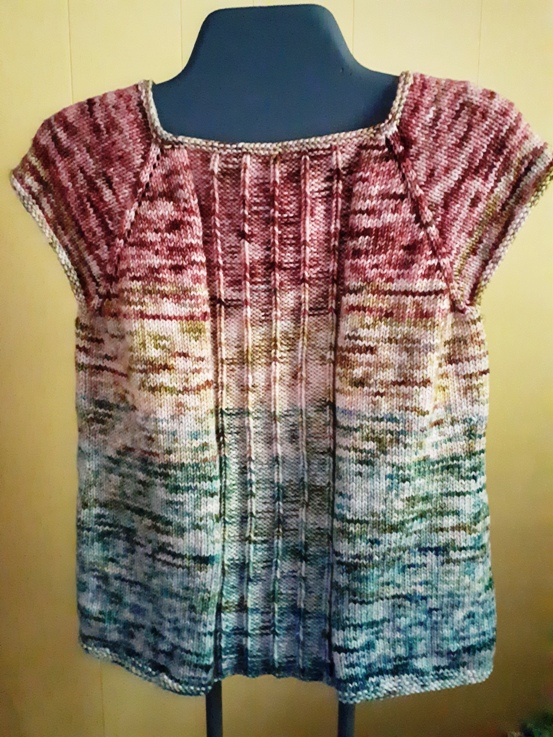
Just For You V Pullover

You have probably seen it but if you haven’t, I published the Just For You V Pullover pattern, even though I haven’t finished the sleeves!

It’s available for free at Debgemmellmods store on ravelry.

No one seems to have minded the “no sleeves” thing but I am knitting them now, two at a time. I heard it builds character to finish things. I’m not sure I need more character but here I go anyway.

Waxwing Wool Co.

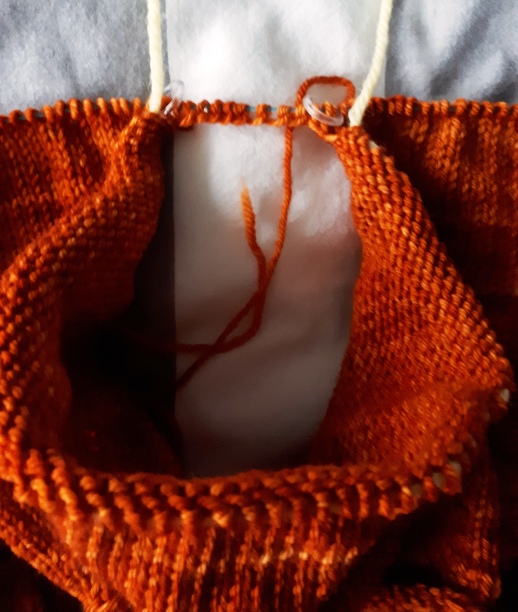
This is how they sit on my lap when I knit them both at the same time. I work them on two circulars.

This is a video of the last time I did this.

Have you tried it?

There is no way around the fact that knitting in fingering weight wool takes a very long time!!!

I’m afraid I have not made any further progress on the green one, or anything else.

The kids and our grandson were up for a week and lots of board games, group meals and general busyness ensued. Not much knitting at all. Summertime at the lake, wouldn’t miss it for anything.

I hope your summer is going fantastic.

Cheers, Deb

Any Gauge and Gauge-free patterns by Deb : https://www.ravelry.com/stores/debgemmellmods

Debgemmell 435 on YouTube: https://youtube.com/@debgemmell435?si=fA-GDr5DuciuKomI

Deb.gemmell on instagram.

Knit to Fit: More bust shaping

My theory is that the front of our sweaters should be wider than the backs for two obvious reasons.

We don’t need it to be wider everywhere. Just where we need it. (Do I need Bust Darts?)

This is a refined version of the Knit for Fit: Top Down Easy Bust Shaping and what I actually do for many of my sweaters. The Family Crew Neck and the Any Gauge Raglan Pullover have the instructions to do this in the Modification Pages.

As I approach the bottom of the yoke, I work an extra increase beside the raglan increase ON THE FRONTS ONLY. Now I have added an extra stitch on both sides of the front. (The black slashes are where the extra increases are.) I usually do this for several rows or rounds.

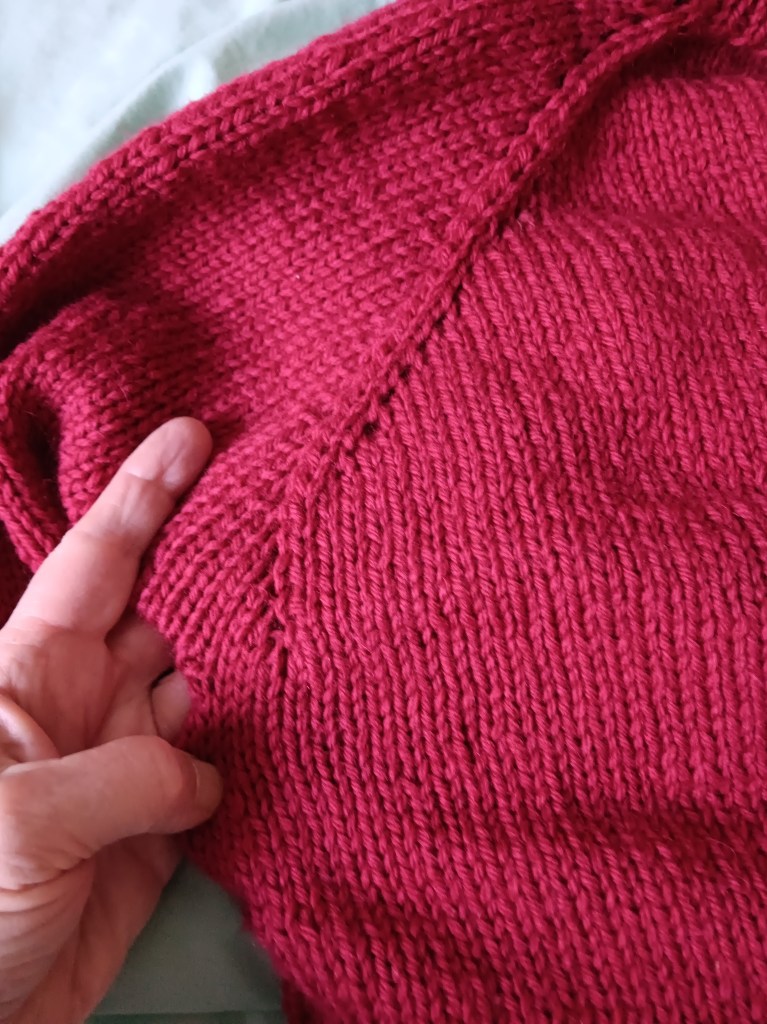
Here’s a more obvious example on a sweater I’m knitting now. In Aran weight yarn (heavy worsted) you can see the increases clearly. I did quite a few because this is a cardigan and I didn’t want the dreaded button pull on the front.

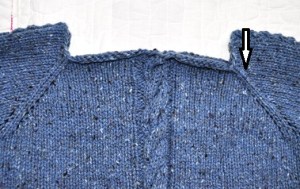
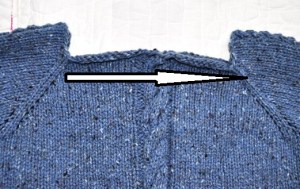
The change from the last post is that at the same time I was working these extra increases on the fronts, I STOP INCREASING ON THE BACK. Can you do that? Just stop increasing? Yes you can.

This is all done very close to the bottom of your yoke. You get a little straight line on the back, very near the underarm, so no one can see it.

  1. The bonus is that my back is now 2+” narrower than the front of my sweater.

2. The second bonus of working the extra increases beside the raglan increases on the front and not increasing on the back is that you are still increasing 8 stitches on every increase row or round. It doesn’t mess with the number of stitches you need at the bottom of the yoke.

You do have to work decreases down the sides of the front body between the largest point of your bust and your waist to take all or some of these extra front stitches away. Then begin your hip shaping.

Yes, shaping your sweaters does have lots of parts to it. Try one step at a time. You are the boss of your knitting.

Cheers, Deb

Any Gauge and Gauge-Free patterns by Deb

Deb.gemmell on instagram

Knit to Fit: Top Down Easy Bust Shaping

Would you like the front of your sweater to be wider than the back? There are two obvious reasons why you might need that. Knit to Fit: Do I Need Bust Darts?

If you are working a casual Raglan sweater from the Top Down here is an easy way to get some extra width across the Front just where you need it: not over the entire front of the sweater and expecially not around the top of the shoulders and neckline, just at the bust.Body schematic bust shaping Top Down

As you work down your yoke, you are working increases at the raglan lines.Top Down pullover schematic

As you approach the bottom of the yoke, what would happen if you doubled up the increases on the Front only? Wouldn’t there be more width on the Front?

In the bottom couple of inches of the yoke, on the Front only, you could work an additional M1 increase beside the raglan increases you are already working, separated by a stitch or two. This could easily add an extra 2″- 3″ to the Front.Bust shaping Yoke increases Body schematicWould the extra increases show? Not really. You can put them in just before the underarm. Can you see them?Everyday Cardigan close up bust shaping yoke

They’re right there.Everyday Cardigan close up bust shaping yoke showing

At my gauge of 5 sts = 1″,  5 extra increases on each side of my front (yes I did work 5 extra  increases but I can’t find the 5th one) for a total of 10 extra stitches, which gives me 2″ of extra width across the front, above my bust. Great for my casual cardigan.Everyday Cardigan Yoke shaping

Now for the nitty gritty details. Here is an example of how it works for a cardigan:

Double Increases on Fronts for Bust Shaping

Increase Row: (RS) Work across the Front to 2 stitches before Marker#1, M1L (extra increase for bust), K1, work your regular raglan increase, K1, slip Marker#1, K1, work raglan increase, work across Sleeve to 1 stitch before Marker#2, work raglan increase, K1, slip Marker, K1, work raglan increase, knit across Back to 1 stitch before Marker#3, work raglan increase, K1, slip Marker#3, K1, work raglan increase, work across Sleeve to 1 stitch before Marker#4, work raglan increase, K1, slip Marker#4, on the Front work K1, work raglan increase, K1, M1R (extra increase for bust), knit across remaining stitches of Front to end of row. – increase of 10 sts, 8 raglan increases + 2 extra bust increases on Fronts only.

You can use this in addition to other bust shaping techniques for more width or shaping. You can add this shaping to any Top Down Raglan sweater pattern where the front and back are the same width.

You can decrease these extra bust stitches away as you work towards your waist or leave them there. It’s a casual cardigan so I just left them there. It helps to prevent button gap.

There it is. One easy way to make some extra width for your bust.

Thanks for reading,

Deb

M1L: Work before the Raglan line:  With Left needle, lift the running thread between the stitch just worked and the next stitch, from front to back, and knit into the back of the resulting loop.

M1R: Work after the Raglan line:  With Left needle, lift running thread between the stitch just worked and the next stitch, from back to front, and knit into the front of the resulting loop (this is tight to work).

ANY GAUGE and GAUGE-FREE patterns by Deb

Cabin Fever No-Sew patterns

Deb on instagram


Ease for a Top Down Raglan

Ease is really personal. Ease is the amount the finished sweater is bigger or smaller than the measurement at your bust line. How tight or loose you wear your clothes across the bust, is entirely up to you. Two people with the same bust measurement may knit two different sizes, depending on how they want their sweater to fit.

Positive ease means the sweater is bigger than your Actual Bust Measurement. A sweater that measures 44″ around on a body with a bust measurement of 40″ has 4″ of positive ease.

You can have negative ease too. If the sweater measures 38″ around the chest on a body with a bust measurement of 40″ then the sweater is said to have 2″ of negative ease. The T-shirts you wear usually have negative ease. It does not mean it’s 2″ smaller everywhere. If the sweater is knit straight it may have positive ease on the torso even if it has negative ease at the bust line. Apparently, in the knitting industry, we are only concerned with the fit at the bust line. Go figure (pun intended).

For the Any Gauge Raglan Pullover I was attempting to fit a pullover with some positive ease. At the Bottom of the Yoke this sweater would fit like a second skin. It fits your Actual Bust Measurement + both your Actual Arm Measurements. It fits your body exactly as measured. But we don’t leave it there.

In this pattern I have you add the Ease as a cast on at each underarm.

How much ease? That’s up to you. The easiest way to determine how much is to measure the sweaters you wear. How much bigger/smaller is your favourite sweater than your Actual Bust Measurement? That’s the amount of ease you like. Half the ease is added as cast on stitches at one underarm and the other half, cast on at the other underarm. Now your sweater body has the amount of ease you wanted.

You can see that half the Body Ease will eventually also be added to the sleeve. Let’s say you want 3″ of ease for your body, then 1.5″ is cast on at each underarm. When you work your sleeve, you pick up one stitch for each underarm cast on stitch, so adding 1.5″ of ease to the sleeve.

But … you knew this was coming, there are modifications you can make here.

  1. Different ease for your sleeve: If half the Body Ease is not the right amount of ease for your sleeve, as you set up your sleeve you can pick up additional stitches in the corners beside the cast on stitches for slightly more sleeve room or for less ease, pick up fewer stitches from the cast on stitches. It won’t involve very many stitches + or – so is fairly easy to do.
  2. You miscalculated your gauge: Your pullover at this point is a little smaller than anticipated. You can cast on additional stitches to add body width plus the amount of ease you wanted, as you cast on at each underarm. If your sweater is too big at this point, sorry you’re going to have to rip back several rounds before you cast on for the underarms.
  3. Yoke is getting too long: Your pullover yoke is already level with your underarm so you don’t want to work any more increase rounds to get to your total number of stitches at the bottom of the yoke. You can cast on the extra Body stitches needed to get to the correct number of stitches at the Bottom of the Yoke at the underarms (divided between the two underarms) along with the amount of ease you want.
  4. You want Negative Ease: Work until at the Bottom of the Yoke your sweater is the number of inches of negative ease you want plus extra 1″ smaller. Then cast on 1/2″ worth of stitches at each underarm. For example, if you want 2″ of negative ease then knit until your Yoke is 3″ smaller than your Actual Bust Measurement (2″ negative ease + 1″ smaller). Cast On 1/2″ worth of stitches at each underarm. This will make your sweater come out to the amount of negative ease you wish plus add a little ease to your sleeves.
  5. Extra Bust Width: You want to add some extra width to the Front only. Take your Total Sweater Ease at the Bust – Ease added on the Front only = cast on the underarms, divided between the two underarms. For example: Total Sweater Ease at bust is 5″ – 2″ added to the Front only = 3″ ease to Body at the underarm (1.5″ cast on at each underarm).

You might guess what I did. Give up? Yes, I added extra ease across the Front only. We’ll get into that next.

Cheers and stay safe and well, Deb

Any Gauge and Gauge-Free patterns by Deb

Deb on instagram for all my other knitting

Under the Bust Shaping

Is it too early to think about knitting garments? Too late, I’ve already started but I don’t want to repeat this …

The cardigan is finished. I’m so excited as a stand in front of the wall of buttons at the Fabricland store trying to choose the perfect buttons. These ones, no maybe these ones. I’ve decided on the blue ones (ha, almost always). I’m rushing home to sew them on. Oh, it looks gorgeous. I’m patting myself on the back as I put it on and stand in front of the mirror.

I tug it a little, tug a little more and get that horrible feeling as my heart drops down to my toes.

I have that horrible buttonband gaping. Can I wear it without buttoning it up? Maybe, I guess I could but I really like 3 or 4 buttons done up.

That was several years ago before I realized that I had to have some extra width right here.Body schematic bust shaping Top DownNow as a confirmed cardigan buttoner I add extra Front stitches for Bust Shaping to every cardigan. Then I have extra width just where you need it.Bust shaping Yoke increases Body schematic direction of knittingBut now what? What do you do with those extra stitches below the bust?

This is my current cardigan. I decided to knit this Top Down to my regular Finished size, including the ease, and then add even more additional width above my bust. I don’t want that unsightly buttonband gap that seems to show up in so many magazine photos. Negative ease on a cardigan across the bust is a mistake.

20190723_145811

Now I’m cruising down the body with the extra width across the bust. Decision time, do I want these extra stitches to remain on the front for the entire body? Sometimes the answer is yes and sometimes no.

This time it’s no. I’m going to decrease those extra bust stitches away so that my two Fronts and the Back are in their original proportion: 2 Front sts added together = Back sts.

Techy Talk:

I worked straight until I had knit just past the largest part of my bust. For me that’s 4″ measured down from the underarm cast on.20190717_105637-1.jpg

This time I decided to decrease the extra bust stitches or most of them anyway, worked along with some waist shaping. So here goes.

On a Right Side row I’m going to decrease on the front side of the imaginary side seam on both Fronts (that will decrease an extra bust stitch on each Front). Then work a couple of rows and decrease on both the Front and Back sides of the side seams (waist shaping). Knit a couple of rows and repeat.Underbust decreases bust and waist

underbust decreases with 3x3 sweater

I worked this repeat quite quickly with only a couple rows in between the sets of decreases. I’m very short and I needed to start the A-line shaping for my hips pretty sharpish to get the width I needed there. If you are tall, first of all I’m envious, and second you can space these sets of decreases further apart so that you work them down to your waist. It will look terrific.

Cruising to the bottom edge now. Yay. Sleeves here I come.

Thanks for reading,

Deb

Any Gauge and GAUGE-FREE patterns by Deb

Cabin Fever pattterns and Books

Deb on instagram

Any Gauge Raglan, it’s done

Maybe you wake up one morning and decide today is the day you’re going to cast on for a pullover for yourself. It’s time. You go to your stash and pick out some yarn that has been calling to you. You check through your library of patterns at home or on ravelry to see if you have one that matches the pullover you want to make. Time passes, more time passes and you haven’t cast on yet.

What if you could get right to it. Cast on now. That’s what this Any Gauge Raglan pattern is all about.

Any Gauge Raglan Adult front page

I am a problem solving designer. One of my problems and maybe yours too, is that I don’t get gauge with the recommended needle size. I’m a loose knitter so usually go down one needle size to get close to gauge. With this pattern I am going to get to use the unique gauge I get with this particular yarn. One problem solved.

You can Cast On using the gauge information on the ball band if you usually get close to gauge with this yarn (I get close enough with the needle change) or you could do a swatch. Figure out the number of stitches you get in 1″ and you’re ready to Cast On for the neck opening.

DSC_0420

Yes, there is some math, more properly called Arithmetic. Nothing more than taking measurements in inches and multiplying by your Gauge (number of stitches in 1″). You can do this.

I’m really excited to present the Any Gauge Raglan Adult.

Thanks for reading,

Deb

Deb Gemmell Mods Any Gauge patterns on ravelry

Cabin Fever patterns on ravelry

Neckband Boss

Finishing up. Do you love it or hate it? The sewing in of the ends, the picking up of the neckband, washing and blocking, all of it.

I procrastinate. The time between finishing the actually knitting and finishing it up is usually a long time. I started this sweater in September, blush. But look at me now, I am finishing it up.

This was one of the early prototypes for the Any Gauge Raglan Adult and the drop at the shoulders was not as deep as I might like it. I lengthened it on the next sweater but right now I certainly don’t want the shoulder drop to be any shorter than it is.

DSC_0392 - Copy

The pattern calls for me to use a smaller sized needle, pick up for the neckband and then, since the neck opening is quite wide, to work an even decrease around the entire neckband, taking the whole thing in.

Who is in charge of this neckband? ME. That’s right, I’m the boss here. So, smaller needle, check. Pick up and knit stitches, check. Decrease Round, hmmm.

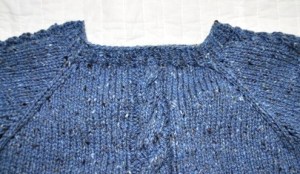
The neckband does need to be smaller so I decided that I need to decrease across the Front and Back only and leave the shoulder stitches as they are. Across the Front and Back I decreased 20% of the stitches and knit across the shoulders.

DSC_0392 - Copy (2) Yes, that brought my neckband in for a smaller neck opening and left my shoulder drop as long as I could. Finish knitting the ribbing and I’m done.
DSC_0397

The boss was right. I’m counting this as a success!!

Thanks for reading,

Deb

Deb Gemmell patterns on ravelry

Cabin Fever patterns

Knitting Guild workshops

Do you belong to a Knitting Guild? I had the pleasure of doing workshops at two different knitting guilds this week. I am also looking forward to my own knitting guild meeting later this week.

Our Couchiching Knitters Guild has been running (under various names and several different locations) for more than 20 years. We were getting so chatty at our meetings that we couldn’t seem to get anything else done so now we go for dinner first and then meet at the Purl3 knitting shop for our meeting. We do a short technical lesson or discussion (this month it’s bring your favourite Christmas gift pattern) and then, the highlight, our show and tell. There is always lots to inspire us: stories of problems, offers of solutions, new books, new patterns, yarn galore and lots of encouragement. It’s always terrific to be with people who love knitting as much as I do.

In Port Hope I lead the Make It Fit workshop. I was impressed by the number of sweater knitters in this group. We explored small additions to a pattern that can make a sweater fit each of our unique figures. Yes, the person who has to make a sweater fit really well is you.

Female-Body-Shapes Workshop (2)

We discussed why you need to make accommodations and where you would incorporate each technique. They knit a little sample to try out several techniques:  Easy Bust Shaping, Bust Shaping with Twin Stitches, Where is your Waist. Knitting the sample seemed to make it all more real and open up the possibility that they could actually add the shaping they needed on their next sweater. Because they are a guild they now have the support to make this happen.

At the Knotty Knitters guild meeting in Peterborough we explored taking a raglan pattern and seeing if we could make changes to the yoke and come up with something different.

20181018_204518

I truly believe that every knitter has a designer inside them who wants to get out and try something. This is the class for that knitter. There are so many possibilities and places to go using a raglan pattern. This workshop has produced these two patterns so far:  Kid’s Diamond Pullover

20180419_113837 - Copy

and Kid’s Summer Topper.

20180419_112048 - Copy

There will be more coming down the pipe.

That was my exciting week. Next weekend is the Cabin Fever Retreat where we are doing all things I-Cord. The fun never stops!

Thanks for reading,

Deb

Cabin Fever patterns and Books on Ravelry

Knit to Fit and Fade

My first fade is finished. I love it. I knit it in Dragon Strings,   Fairy Wrap (worsted weight) in Dirty Hippy colourway with 4 colours. The Fade stripes were easy to work and it’s so much fun getting to see the next colour blend in. I would totally do another sweater this way.

20180924_094823


KNIT TO FIT:    Usually your Top Down pullover will have a specific number of stitches to reach for the bottom of the yoke. That was the case here but I still wanted to have extra width across the Front for 2 obvious reasons. The easiest way to do this was to work the increases that would normally be worked on the Back, on the Front as extra increases. The stitch count remains as it should and there would then be extra width on the Front where I needed it.

Continue reading “Knit to Fit and Fade”

Raglan Sleeve Freedom

Have you ever checked the measurement of your arms? Does the sleeve of every sweater you knit come out correctly for you? Is that stopping you from knitting for yourself?20180809_112733

We use the bust measurement to choose a sweater size to knit but does that mean that the corresponding sleeve is going to fit also? As I age I find I need larger sleeves than many patterns will give me, especially if the pattern is written by someone younger and smaller. If you are busty you may find that you need a narrower sleeve than the pattern is going to give you. If you are plus sized you definitely need to check your arm size against the schematic to check the fit.

Continue reading “Raglan Sleeve Freedom”