I know I’ll be really glad I have long sleeves on this sweater. I know that, but … sleeves, OMG, do they have to take soooo long?
About 4 years ago I started this: Two Sleeves on 2 circs. It’s the same as working socks two at a time. If you’ve done that, this might be for you.
No second sleeve syndrome for me.
So here I am with the purple sleeves of my 6×6 Cardigan. I knit one inch of knitting on each sleeve separately. Then I slipped the stitches of the sleeves onto two circular needles with the underarm sections facing each other. (You might be able to see that one circular has a blue cord and the other has a red cord.) I put a big pin in the fabric at the underarms of the sleeves to hold them in position on the two circular needles. I’m only about 2″ in so far, with many hours ahead of me.
You know that I really, really, want to cast on something new right now. I’m resisting so far. I can do this, I can, I can?!
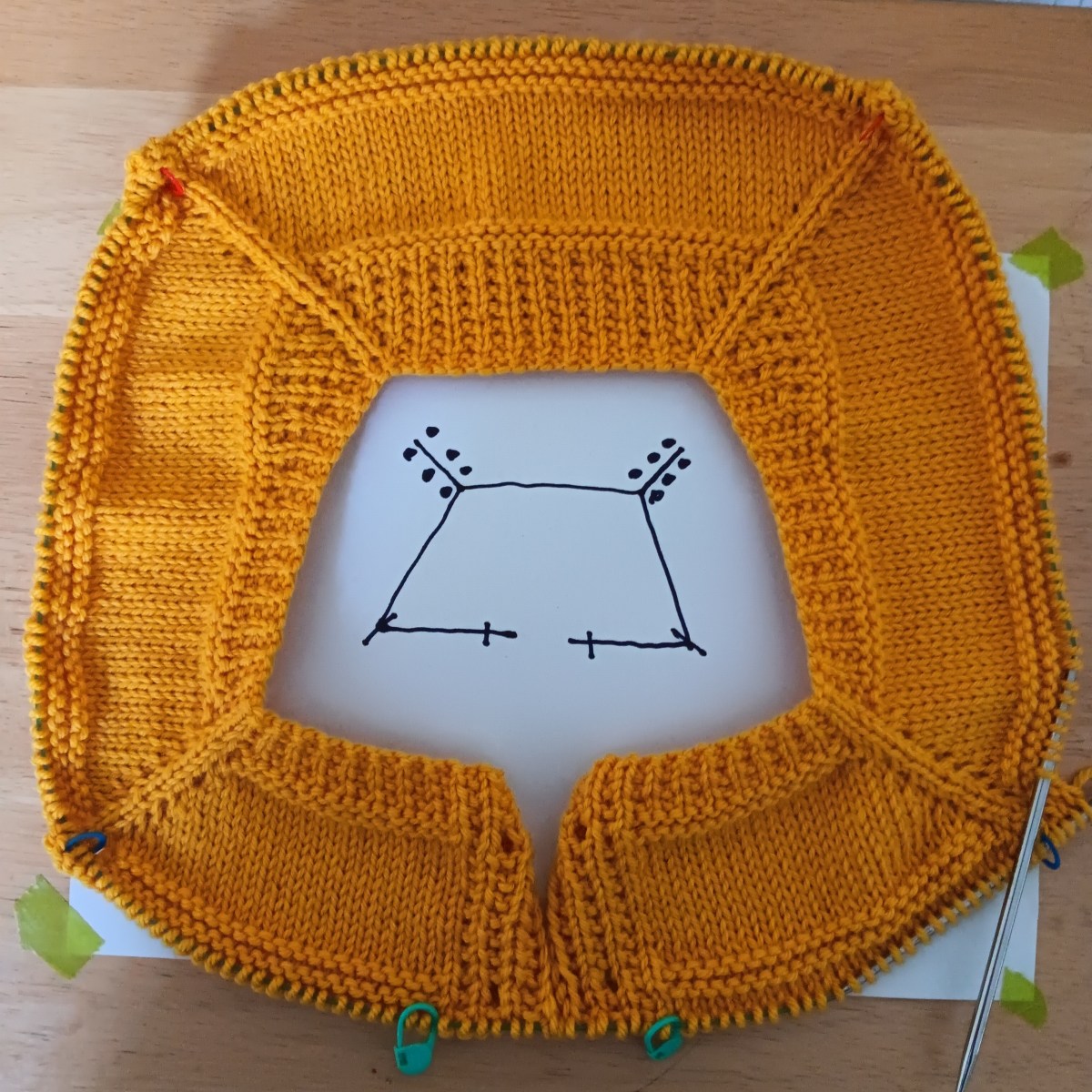
I am on to a new idea: a cardigan with a square neck opening. It will be a pseudo crew neck, I guess.
I’m also experimenting with videos. There are three here. Let me know what you think. It’s so much easier for me to talk, rather than write, about a new idea. (You may have to turn the volume up. No idea how all this works yet.)
The Back of Neck is 2″ narrower than the two fronts added together, as they would be if they were buttoned up. It will be interesting to see how the neck fits.
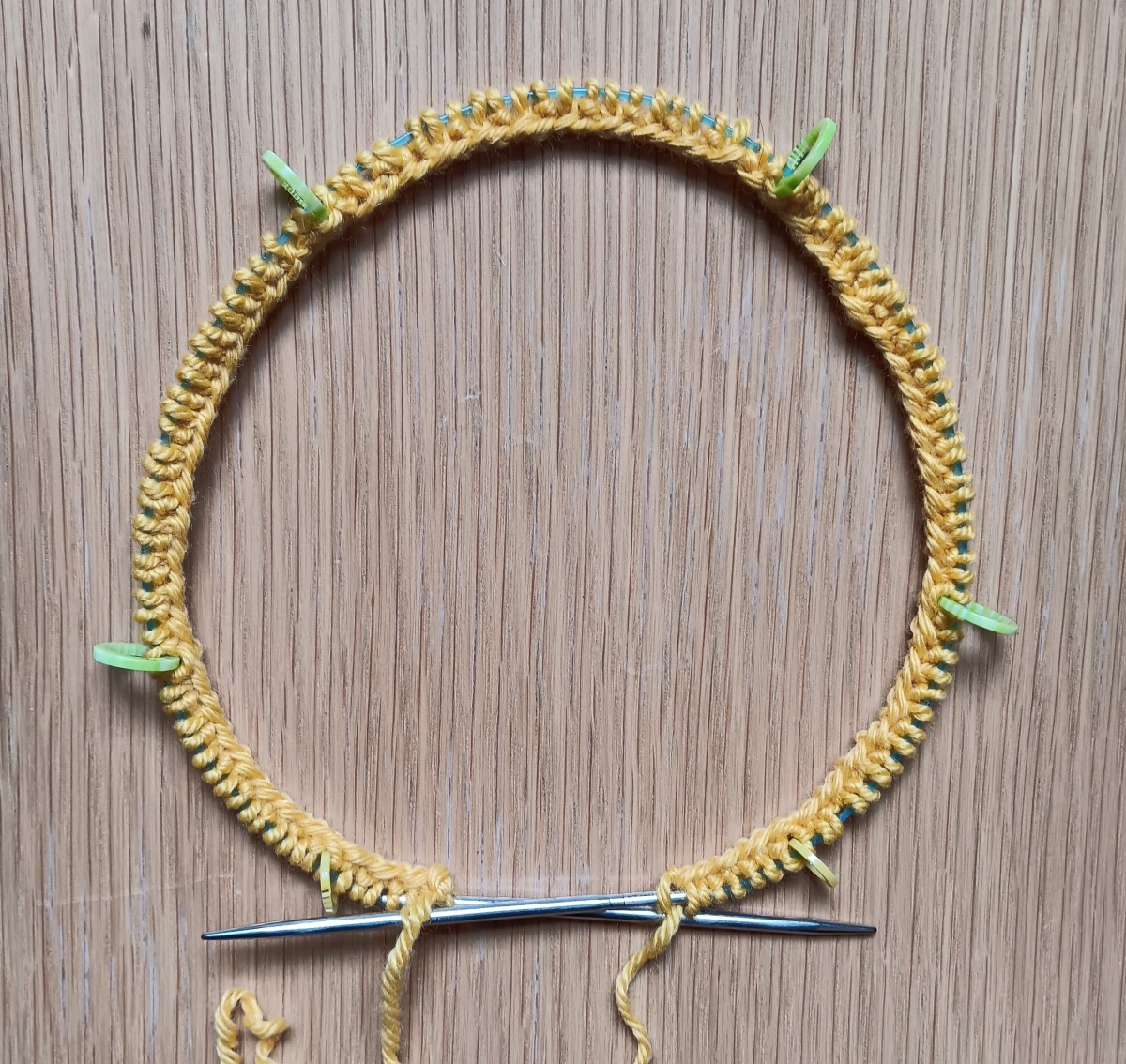
Here is the cast on with green raglan markers in place and two yellow markers to delineate the buttonbands.
Here we go, my first try with the short rows across the back of neck. They seem to be working fine.
I did a video of a really easy way to work short rows in a ribbed neckband.
I’m excited. Are you on the edge of your seat? LOL!!! Cheers, more next time. Deb
My favourite way to begin a Top Down garment is with the ribbed neckband. I’m not enamored with picking up stitches around the neck opening and would rather just jump right in and get going.
This is going to be a new Any Gauge project: a V-neck cardigan.
The Back of Neck in this type of Top Down tends to stretch. I have been experimenting with ways to make a firm edge across the Back of the Neck on the last row of the ribbed Neckband. Here it is.
Let me know if you try this. I think it’s working for me.
What if … the raglan markers on your Top Down sweater were only a guideline for the size of your sleeve and not the exact size of the sleeve?
“Why don’t you knit sweaters for yourself?” I have asked this question of a lot of knitters. The answer, quite often, is that the sleeves never fit. A lot of knitting pattern sizes are based primarily on the measurement around your bust. If your bust measurement and your arm measurement don’t agree with the size chart the designer is using, then you are not getting a good fit.
This is one of the problems I wanted to solve in the adult sizes of my series of Any Gauge Raglan patterns. I have written these patterns for one person at a time – you. You don’t have to compare yourself to a size chart.
In these patterns, you take your bust measurement and arm measurement with a tape measure, and, after converting to the number of stitches, make the raglan yoke to these measurements (Bust + Arm + Arm). Yes, when you finish the yoke,it would fit you like a second skin.
Then you put the exact number of stitches for your arm on spare yarn for your sleeve.
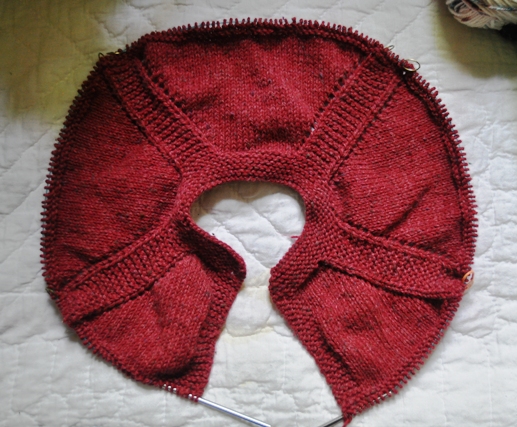
Here is the bottom of my Family Crew Neck yoke with one set of sleeve stitches on spare (red) yarn.
My sleeve stitches on the spare yarn are inside the raglan markers.
In this case my sleeve stitches are 6 sts narrower (1.25″ narrower) than where the raglan markers would indicate. Whether the sleeve stitches end up inside or outside the raglan markers depends on where the markers are set up in the neckline and the size of your arm, of course.
But it fits like a second skin? How is that going to work?
Wait, there’s more. Cast on the number of stitches you need for the amount of ease you want on the body. It could be anywhere between 4″- 7″ or even more, if you wish. Cast on 1/2 the ease at one underarm and the other 1/2 at the other underarm.
Now this sweater body has been knit to your specific measurements at the bust and arm. Ease has been added. This sweater body will fit you and only you.
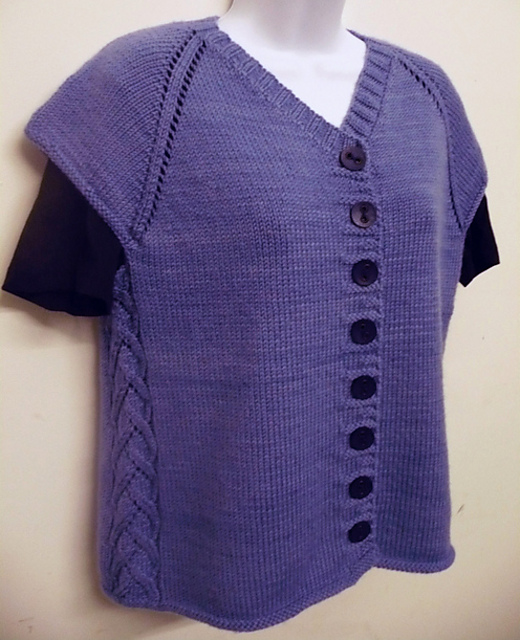
This vest, and the cardigan I’m modifying it from (Build a Bigger V), will be Gauge-Free. No swatch needed. No talk about gauge at all, none, throughout the entire pattern. How freeing is that?
How can it possibly work?
Start with a couple of stitches and build a triangle with increases worked on either side of the centre marker. Work until the solid edge of the triangle is the width of the Back of Neck. Mine is 8″ wide.
Width of Back of Neck is 8″.
That sets the number of stitches for the Back Panel. You need to count the number of stitches you set up with at this point but we don’t care how many stitches per inch you are getting here. Any number of stitches will work.
Now, I will keep the same stitch count as I knit the back panel.
The shaded part here is the Back Panel. The triangle begins at the Back of Neck and the Back Panel is knit down to the desired length.
The decision will be how long I want this vest to be. Lots of knitting for the next week.
I want to knit a vest. That’s not so weird, right? They are handy to have. Winter is coming and I want to be prepared.
I could make it in the normal vest way: start with the shoulders and knit the front to the underarm, knit the back, join in the round at the underarm, and well, you get the picture. But no, not doing that because of … the idea.
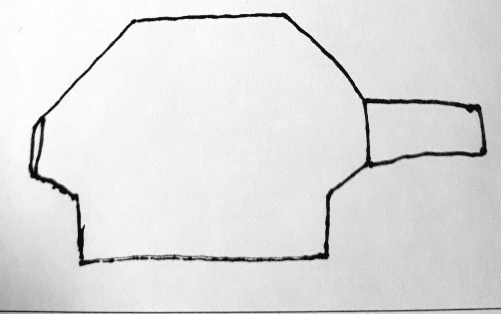
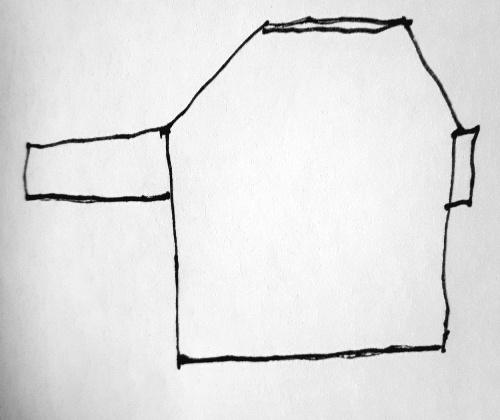
… where the shoulder is narrower. How can I shorten the shoulder section so that when I cast off the sleeve stitches I have what looks like a sleeveless armhole?
Yes, this is my big question. I know, I know, why bother? Sometimes a question like this grabs my attention and won’t let go so … here we go.
I’ve been checking out the sloped shoulder sweaters for a while now. There are many variations.
Have you done one of these? What did you think of it?
I am knitting the Centerpopover which is this one. We’ll call it #1.
Would you call this a batwing or a dolman style pullover? The shoulder line is extended out past the body. The long sleeve would extend straight out from the extension. When blocked, I think the long sleeves would slope down slightly.
I blocked mine and stretched the shoulder line. I wanted the sleeves to come down my arms to form short sleeves.
Here is #2. This one has some shaping. The shoulder line is again extended past the body line but then decreases are worked along the sleeve opening. The sleeves would definitely extend the shoulder slope.
Would this one also give you a batwing/dolman look? You could definitely work decreases in the body below the sleeves to get that effect.
Then we have a simpler style with a straight body line. #3
The sleeve would angle down a bit when worn. At least I hope it would.
And for #4.
A straight body line again. Short rows are worked at the top of the long sleeves so that they match the shoulder slope.
I’m finding all of this most interesting. Have you knit one of these? Did it work for you?
It’s time to get the cardigans out, at least in my neck of the woods it is. It’s also past time to finish a cardigan that I started in the spring. How about you? Are any of your sweaters begging for some attention?
My design process is really slow. I knit a prototype, this cardigan, and then I write the pattern. Now from my written pattern I knit another sample. That’s where I am now, so this is going to be a quick post because I need to get cracking on my second cardigan.
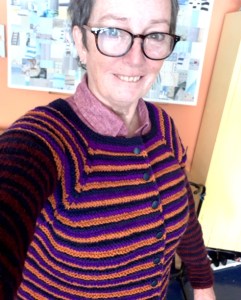
Ta, da, I pretty proud of myself for finally finishing my first 3×3 colour cardigan. I even sewed the buttons on yesterday. That usually takes me months to get around to. Oh, wait, it did take me months!!
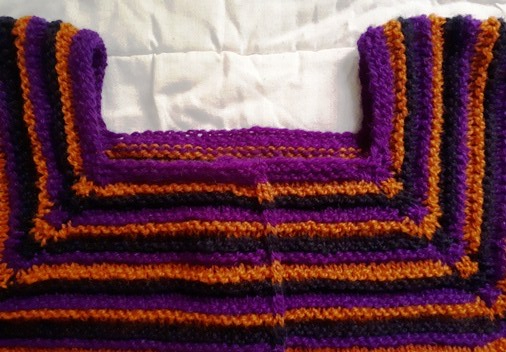
The last bit of knitting I had to do was to raise the back of the neck. To get a lower front on this Top Down I made the shoulders quite wide when I cast on. That means the back of neck was low too. Whoo, that really is quite a dip in the back!
I needed to fill in some of the back of neck dip for the cardigan to be comfortable. I picked up a stitch for every cast on stitch and worked short rows, making the first turn in the centre of the far shoulder, turned and work to the centre of the other shoulder and turned again. I worked 2 stitches further toward the front with each short row and turned again. The back of neck is over an inch deep now and the front is less than 1/2″.
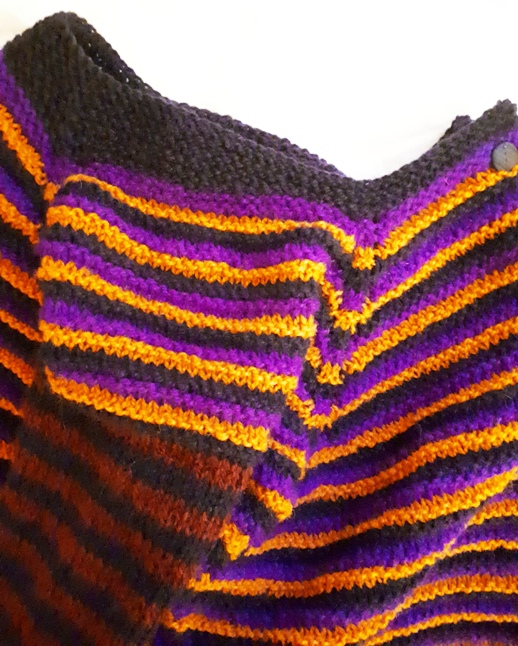
Finished. I did it all in garter stitch using German Short Rows which I think work really, really well with garter stitch. You only have to learn how to do the short rows knitwise, bonus. Here’s a side view of the neck shaping. It’s all happening over the shoulder stitches.
Today I’m casting on another 3×3 colour cardigan in DK weight Cotton Tweed this time. My pencil is poised over my written instructions. Ready, set, go.
Want to try something new, maybe experiment a little (otherwise known as designing)? Why not try it on a little person sweater first. They’re quick and little people are generally not too fussy as long as you choose the right colour.
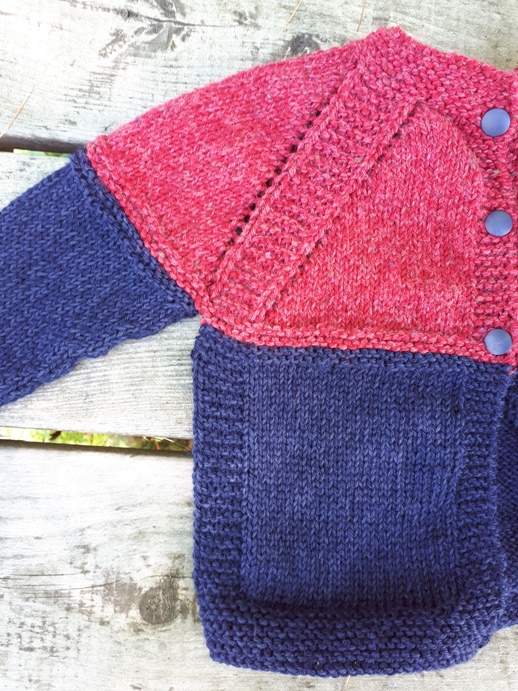
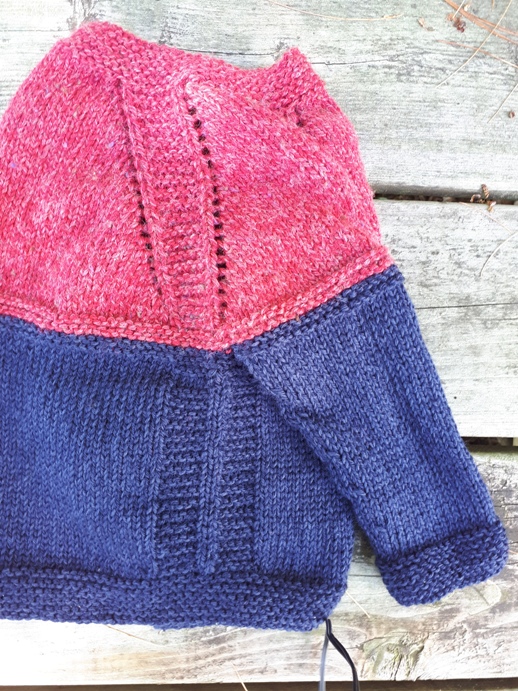
Karen asked me about adding a stitch pattern to the raglan lines since she wanted to try it herself. I dug around in my UFO pile of experiments and found something I had started. I don’t even know when. Not finished, imagine that!
And now it is. It’s in two colours because I didn’t have any more of the original colour dye lot (shh, don’t tell).












 Deb Gemmell: Top Down, Gauge Free and more