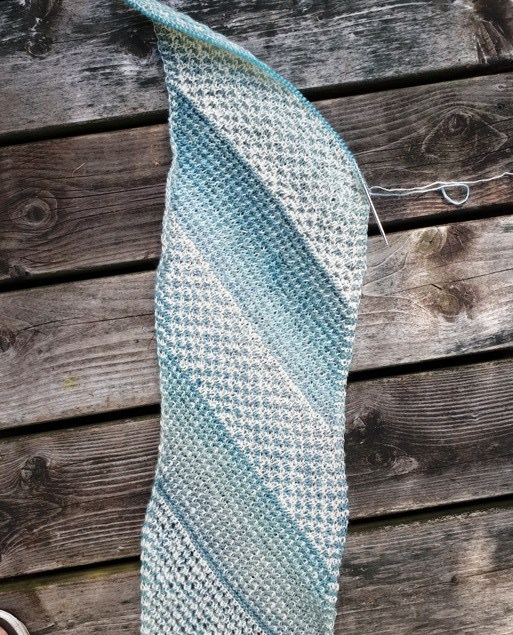
Knit Two Sleeves at a time

Is second sleeve syndrome a thing? If you suffer, here is a solution. Knit both sleeves at the same time on two circular needles.

It’s a messy start, which you know if you have ever attempted to knit two socks at the same time. So here goes.

This is my Lunenburg pullover which I am really anxious to wear. I have done 5″ on both sleeves. It’s going to be a fabulous spring sweater.

Meanwhile, the Twelve-Point Circular Yoke is moving along. I’m past my waist now and have been working some hip shaping on the Back of this sweater. The end of the body is in sight, well, not exactly in sight, but you know what I mean.

Working on only 2 sweaters feels like monogamous knitting to me. I think I need to add another project to be comfortable. Maybe a pair of socks would fill the void. I’m thinking of casting on this week. I think I know which pattern I’m going to use, but I hate to say it because then I’ll probably change my mind, so it will be official once they are on my needles… although a shawl would be nice too. Sigh, so many options.

How about you? Is spring tempting you to cast on?

Cheers, Deb

Any Gauge and Gauge-Free patterns by deb

deb.gemmell on instagram

Debgemmell435 on youtube

Stabilize the Back of Neck of a Top Down

My favourite way to begin a Top Down garment is with the ribbed neckband. I’m not enamored with picking up stitches around the neck opening and would rather just jump right in and get going.

This is going to be a new Any Gauge project: a V-neck cardigan.

The Back of Neck in this type of Top Down tends to stretch. I have been experimenting with ways to make a firm edge across the Back of the Neck on the last row of the ribbed Neckband. Here it is.

Let me know if you try this. I think it’s working for me.

Cheers, Deb

Any Gauge and Gauge-Free patterns by Deb

More Videos by Deb on Youtube

Deb on instagram

Knit to Fit: Top Down Easy Bust Shaping

Would you like the front of your sweater to be wider than the back? There are two obvious reasons why you might need that. Knit to Fit: Do I Need Bust Darts?

If you are working a casual Raglan sweater from the Top Down here is an easy way to get some extra width across the Front just where you need it: not over the entire front of the sweater and expecially not around the top of the shoulders and neckline, just at the bust.Body schematic bust shaping Top Down

As you work down your yoke, you are working increases at the raglan lines.Top Down pullover schematic

As you approach the bottom of the yoke, what would happen if you doubled up the increases on the Front only? Wouldn’t there be more width on the Front?

In the bottom couple of inches of the yoke, on the Front only, you could work an additional M1 increase beside the raglan increases you are already working, separated by a stitch or two. This could easily add an extra 2″- 3″ to the Front.Bust shaping Yoke increases Body schematicWould the extra increases show? Not really. You can put them in just before the underarm. Can you see them?Everyday Cardigan close up bust shaping yoke

They’re right there.Everyday Cardigan close up bust shaping yoke showing

At my gauge of 5 sts = 1″,  5 extra increases on each side of my front (yes I did work 5 extra  increases but I can’t find the 5th one) for a total of 10 extra stitches, which gives me 2″ of extra width across the front, above my bust. Great for my casual cardigan.Everyday Cardigan Yoke shaping

Now for the nitty gritty details. Here is an example of how it works for a cardigan:

Double Increases on Fronts for Bust Shaping

Increase Row: (RS) Work across the Front to 2 stitches before Marker#1, M1L (extra increase for bust), K1, work your regular raglan increase, K1, slip Marker#1, K1, work raglan increase, work across Sleeve to 1 stitch before Marker#2, work raglan increase, K1, slip Marker, K1, work raglan increase, knit across Back to 1 stitch before Marker#3, work raglan increase, K1, slip Marker#3, K1, work raglan increase, work across Sleeve to 1 stitch before Marker#4, work raglan increase, K1, slip Marker#4, on the Front work K1, work raglan increase, K1, M1R (extra increase for bust), knit across remaining stitches of Front to end of row. – increase of 10 sts, 8 raglan increases + 2 extra bust increases on Fronts only.

You can use this in addition to other bust shaping techniques for more width or shaping. You can add this shaping to any Top Down Raglan sweater pattern where the front and back are the same width.

You can decrease these extra bust stitches away as you work towards your waist or leave them there. It’s a casual cardigan so I just left them there. It helps to prevent button gap.

There it is. One easy way to make some extra width for your bust.

Thanks for reading,

Deb

M1L: Work before the Raglan line:  With Left needle, lift the running thread between the stitch just worked and the next stitch, from front to back, and knit into the back of the resulting loop.

M1R: Work after the Raglan line:  With Left needle, lift running thread between the stitch just worked and the next stitch, from back to front, and knit into the front of the resulting loop (this is tight to work).

ANY GAUGE and GAUGE-FREE patterns by Deb

Cabin Fever No-Sew patterns

Deb on instagram


Cables, worked flat to in-the-round

A drop shoulder pullover can be knit in a combination of knit-in-the-round and knit flat, whether it’s knit from the top down or the bottom up. If you add cables to the pattern, like in the Saddle Up pullover, well, it gets a little trickier.

Cable patterns are almost always written to be worked flat, with a right side and a wrong side. The cable crossings are worked on the right side rows. This simplifies things a little bit. You know those right side rows are the ones to watch out for.

At some point, you may need to work in-the-round. Then, you have the right side facing you all the time. Figuring out when to cross cables can be a little more difficult.

Here is a 4-stitch cable, where two stitches are crossed over two stitches, every 4 rows. The lines in the photo indicate the outside stitch of this Left Cross. See that hole just to the left of the crossing stitches? That’s caused by the crossing. (On a right cross cable, the hole would be on the right of the cable.)

When this cable is worked flat, there is a Right Side Row where you worked the cable cross, followed by a wrong side row, right side row and one more wrong side row. On the next Right Side row you would work a new cable cross.

When you work in-the-round you only have the Right Side facing you. Then you have Round 1 where you cross the cable, followed by Rounds 2, 3 & 4. Then cross again.

If you put something straight into the hole created by the crossing and run it under the horizontal bars to the needle, you should see the 4 bars. I used a sewing up needle but your cable needle may be handy and it would work great.

When you can count 4 bars, you are ready to cross again on the next round. If you have a 6 stitch cable, crossing every 8 rows/rounds, you would work until you can count 8 bars from the hole created by the last crossing. It works.

Cheers, Deb

Any Gauge and Gauge-Free patterns by Deb

Cables without a cable needle

Have you tried this? I don’t use a cable needle. I was going to say I don’t own one but I think I do. It’s in the container with my set of straight needles which I also don’t use. Why do I still have them? That’s a very good question. Let’s not go there today.

One of my internet friends wanted to know how I get my cables to look so neat and tidy. My first thought was that I had no idea. I just do them and they turn out that way. But then, the next day, I remembered that I don’t use a cable needle. It’s not that I didn’t know I don’t use a cable needle, that would be sort of crazy, it’s that I haven’t used one for quite a long time so it doesn’t occur to me that they are needed to work cables.

So I did a video to show you how I do it. Thanks CD for the question that prompted this. I hope this visualization helps.

No Cable Needle video

There are tricks to do this:

  1. Only use the tips of your needles. Push all the stitches on your needles to the tips so you can maneuver your needles without pulling any of the stitches.
  2. Take your needles to the stitches. Load the stitches going to the Back first. Once they are on your needle, Leave Them Where They Lie, usually slightly to the back of your work. Don’t move them because they will pull the stitches that are still hanging free.
  3. Load the stitches going to the Front.
  4. Cross the stitches to the Right or Left and load the stitches on your right needle onto the left needle. Check that you crossed them correctly. If not take them off and start again.
  5. Knit across the cable stitches.

It’s a little risky but so satisfying and no cable needle to lose, imagine that!

Cheers, Deb

Any Gauge and Gauge-Free patterns by Deb

Debgemmellmods ravelry group

Setting Up Cables

Designing your own garment? Maybe you are working on the Saddle Up pullover with me and it’s time to work the cables. Here’s what you need to know.

Cables pull your fabric in as soon as the first cable is crossed. You have to make sure you accommodate for this fact or … well, your sweater or project will be much smaller than you had anticipated.

Let’s say you want to work a 4-stitch Rope Cable (worked by crossing 2 stitches over 2 stitches). This cable is worked in stockinette stitch and is a pretty common cable to work.

Once you start crossing this cable, it is no longer the width of 4 stitches. It is closer to the width of 3 stockinette stitches.

If you have a sweater where you want to introduce a 4-stitch Rope Cable, set it up for 3 stockinette stitches to begin with. Then increase 1 stitch before you work the first cross. That’s it.

A basic rule of thumb: for every 3 stitches of the cable, set up 1 less stitch. Add them back in by working increases before the first cross.

Here’s another example: 6-stitch Rope Cable where you will cross 3 stitches over 3 stitches – set up 4 sts and before the first cross, increase 2 stitches (now you have 6 sts for the cable).

This is fairly straightforward, except … (you knew this was coming, right?), the more complex the cable, the harder it is to do this successfully. Do I have to say the S word? Yeah, I do. You have to swatch!

Elizabeth Zimmermann had some great advice. Her suggestion was to cast on 96 stitches and knit a hat with all the cables. It will fit someone.

That can work as your swatch. Measure across the cable once you have worked the cross several times. Use your stockinette stitch gauge to figure out how wide the cable is in stockinette stitches. That is the number of stitches to set up and how many stitches you need to increase before the first crossing.

Example: Let’s say you have a 12 stitch complex cable, repeated several times on your hat, measuring 1.75″ across. Your stockinette gauge is 20 sts = 4″ OR 5 sts = 1″. 1.75″ x 5 sts = 8.75 sts, rounded up to 9 sts. Set Up the cable with 9 stitches and increase 3 stitches in the first row to 12 stitches and cable away.

Norah Gaughan has coined the phrase SSE: Stockinette Stitch Equivalent. The SSE for the complex cable above is 9 sts, even though the chart for the cable is 12 sts wide. Yeah, I know, this can mess with your head.

I would like to recommend her book, Knitted Cable Sourcebook for this information. There are tons of cables in this book and they all have an SSE. She’s done it for you. No swatching necessary. I don’t receive anything if you buy this book. I’m so happy I bought it. You might know that I am not a happy swatcher.

The latest section of the Saddle Up pattern is in your ravelry library. Update the pattern and set up your cables. Have fun.

Cheers, Deb

Any Gauge and Gauge-Free patterns by Deb

DebgemmellMods ravelry group

I-Cords, Built-In

Do you know how I-cords work? They are a little bit of knitting magic. When paired with Garter Stitch they do all sorts of good things.

First, 2 or 3 stitches of I-Cord on the outside edges of garter stitch give it a tidy finish. This is sometimes called a Built-in I-cord because you work the I-cord edge as you knit the garter stitch fabric.

Secondly, because these outside stitches are slipped every other row, they give the edge stability. They are a tiny bit shorter because they are not worked every row. These I-cord stitches hold the edges firmly so the edge won’t stretch.

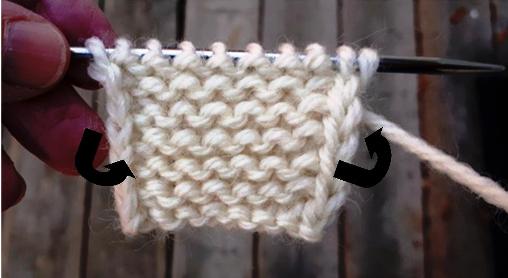
A small sample showing 2-stitch built-in I-cord. It looks the same on both the right side and the wrong side.

Garter Stitch with 2-stitch I-Cord edge: Knit to last 2 sts, bring yarn forward, slip the last 2 sts. This row is worked over and over, on both the right side and wrong side of the fabric.

When you slip the last 2 sts, your yarn is attached to the 3rd stitch in from the tip of the needle because that was the last stitch you knit. So what happens in the next row? You need to pull the wool across the back of your work, from the third stitch to the first stitch so you can knit the row. This pulls the first stitch around towards the back of your work, as you knit it.

On one edge the second I-cord stitch rolls to the back. On the other edge the second I-cord stitch rolls to the front.

Because these two stitches are slipped every other row they look like stockinette stitch. A 2-stitch I-cord is the tiniest tube you can knit around the edge of your garter stitch fabric.

The Saddle Up pullover begins with a Garter Stitch Saddle with I-cord edges, of course.

The Saddle begins at the left shoulder and is worked across to the the right shoulder, with a hole for your head in the middle. Pretty straight forward, right?

But that’s not all there is to it, of course. That would be way too easy. There is another way of working the 2-stitch I-cord.

There are occasions when you would like both the I-cord stitches to be rolling to the wrong side of your work. This can be done, too. The Saddle uses this technique for the Back of Neck stitches.

On both edges the second I-cord stitch rolls to the wrong side of the fabric.

2-Stitch I-Cord rolling to the wrong side: Right Side Row: Knit to last 2 sts, leave yarn in the back, slip last 2 sts. Wrong Side Row: Purl 2 sts, knit to last 2 sts, yarn forward, slip last 2 sts.

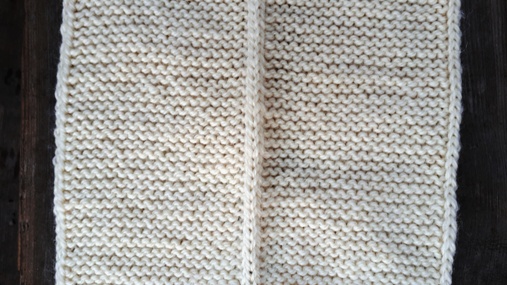
What is that line down the middle of the Saddle? The shoulders of the Saddle for this pullover need a lot of extra stability since the sleeve will be trying to pull it down. So I added some non-stretchy stitches right down the centre. It looks like an I-Cord but it isn’t. The middle 2 stitches are slipped every other row and work the same way, in that these 2 stitches are a tiny bit shorter and won’t stretch. Thanks L for pointing this out.

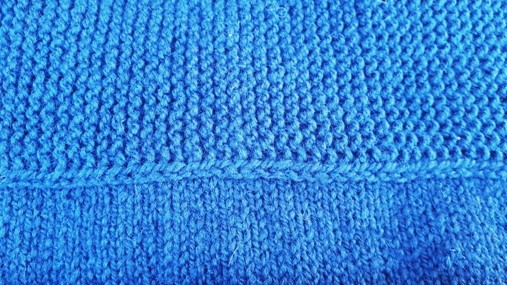
There is one more reason for all this I-Cord business. A 2-stitch I-Cord gives you a sideways stockinette stitch for every garter ridge. In the Saddle Up pullover, stitches are picked up & knit along the bottom edge of the Saddle to form the Front which is worked flat, down to the bottom of the armhole. If you pick up & knit into the I-Cord stitch that has rolled to the back the Saddle, you get a very lovely line of stitches running between the Saddle and the Front. It will never stretch and it’s so very neat and tidy. Don’t you think?

I’ve done the pick up & knit into the I-cord across the bottom edge of the Saddle and have started my cables down the Front.
I picked up & knit along the I-cord stitches on bottom edge of the Back of the Saddle and worked stockinette stitch down the Back.

You can add I-cord stitches to any garter stitch project. You may get to love them as much as I do.

Are you are interested in knitting this Saddle Up, drop shoulder pullover with me? I’m publishing each section as I get it done and tested. I’ll update the pattern with each new section as we go along. The Saddle section is up for sale.

I’m interested in any comments, corrections or problems you have with this pattern. I’ve included lots of photos and my blog posts will be featuring this pullover for the next month. Happy to have you join me.

Cheers, Deb

Any Gauge and Gauge-Free patterns by Deb

Debgemmellmods group on ravelry

And miles to knit before I sleep, and miles to knit …

I knit top down sweaters all the time and I love it. But after the excitement of knitting the yoke, there are all those rounds/rows of knitting to go for the body. Miles to knit, to paraphrase from Robert Frost’s poem Stopping by Woods on a Snowy Evening. What is a knitter to do?

Here is one solution. You are in luck if your top down pattern has a set of stitches cast on at the underarm during the Divide Round/Row. These cast on stitches are a gift to you. They are the perfect place to add a stitch pattern to break up all that stockinette stitch.

You must have a couple of stitch patterns that you love that you could work in here. You can also search through your stitch dictionaries for patterns you can use as a panel of stitches.

Let’s start with some easy stitch patterns:

Garter stitch with 2 centre stockinette stitches to break it up. Railroad Top Down.
A panel of 2×2 rib: P2 and [K2, P2] repeat.

Then you could move on to working twisted stitches. Why twisted stitches? They don’t change the gauge of your knitting so you can just pop them in.

A twisted lattice stitch pattern.
Another twisted stitch pattern where a stitch travels across 4 stockinette stitches from side to side. This could be worked on any number of stockinette stitches. There is a purl stitch before and after the 4 stockinette stitches.

Cables are great too but you have to watch how much they pull the fabric in. Two stitch cables work really well.

Two stitch cables, crossed every 4 rows.

And the last suggestion is to find a lace pattern to work down the side of the body. This is always a very attractive option.

Your stitch dictionary has lots of lace patterns that would fit your underarm stitch count.
Side Pattern Vest

So what do you think? Could you do this on your next top down? Have you taken a step away from a pattern and given this a try?

Cheers, Deb

Gauge-Free and Any Gauge patterns by Deb

Snip, Snip

I need to correct that, this only involves one snip. The scissors are out and ready to go.

I can’t live with this ruffle-effect on my top down neckband.

It was my own error in calculation but sometimes I don’t know what will happen until I actually knit it up. Then denial, denial. It’s not so bad. It will block out. Does this sound familiar?

Unfortunately, it is not going to block out. So now to fix it.

Yes, scissors to the rescue. I cast on this cardigan at the neckband so I can’t rip it back. That only works with a cast off edge.

I’m ready to take the plunge. This is the centre back of the garter stitch neckband. I want to cut so that this row of stitches ends on up my needle.

I must admit to chickening out a bit and going up one more row to be sure to get a good set of stitches. I’ve turned my neckband around. The line at the top is there to show you the base of the neckband.

Here goes. Snip a leg of one stitch. That’s it, only one snip.

By pulling the cut yarn through one leg of a stitch at a time, you are taking out one row of stitches and leaving open stitches above and below. One row I’m putting on my needle. The other row belongs to the neckband I will be discarding.

It’s a slow process. One stitch at a time from the centre back around to the front. Half way done now.

I can think of worst places to do a slow and somewhat tedious job. Not so bad when I’m sitting here. Now to go from the centre back in the other direction.

There, finished. Now I just have to reknit my neckband. Just give me a minute or two … decrease about an inch of stitches along the front  … knitting around … do the same on the other front … straight knitting now … taking a break … knitting … knitting … casting off. Done.

Here’s the before and after. There is a little bit of ruffling on one side but that will definitely block out. Yay. A win.

Would you ever try this?   Deb

Any Gauge and Gauge-Free patterns by Deb

Slip Stitches, different effects

Slip stitches are easy to work. You’ve probably done them to work decreases and maybe a selvage or two. Have you used them to work a decorative 2 colour pattern? If you haven’t here’s how it works on a garter stitch scarf.

Tech notes: Slip stitches are always worked purlwise. That means insert your needle into the stitch as if you were going to purl the stitch and transfer it over to the right needle without working it. It’s simply a transfer of a stitch from left needle to right needle. The yarn, while working the slip stitch, is always carried across on the Wrong Side of the fabric. OK, that’s it.

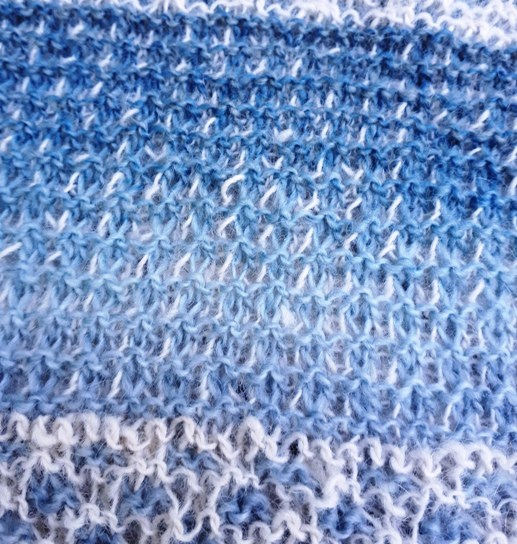
When using 2 colours in a standard garter stitch stripe (2 rows in colour 1 and 2 rows in colour 2), slipping one stitch pulls the colour of the stitch you slipped up into the row you are now working. So working [K1, Slip 1] makes every other stitch a different colour. In this first pattern the white yarn works K1 and the blue yarn is slipped. The blue yarn from the previous row is pulled up into the white row. On the wrong side row the white yarn is knit and the blue yarn is slipped again (with the yarn in front – the wrong side of the fabric). The working yarn (white) moves back and forth between knitting and slipping, much like when you work a 1×1 rib. A bit of a pain but I think it’s worth it.

Rows 1 & 2: With blue, knit. Row 3 (RS): With white, work [K1, with yarn in back SL1]. Row 4: (WS) Work [with yarn in front SL1 (the blue stitch), K1 (the white stitch)]. The white stitches are in garter stitch (knit on both the RS and WS). The blue stitches look like stockinette stitches but they aren’t, they have been slipped over two rows.

20200717_090106

If we can work this as [K1, SL1] we could also work it as [K2, SL2]. Why not? That’s easy enough, right?

This time the first two knit rows are white and the slipped stitch rows are worked in blue. Rows 1 & 2: With white, knit. Row 3 (RS): Work [K2, SL2]. Row 4 (WS): Work [with yarn in front SL2, K2]. You can see the difference from the 1×1 pattern below it. Cool, eh? Just a little change and it looks quite different. Switching which colour works the first 2 knit rows also makes it look different.

20200717_090141

Why stop here. What if on Row 4 (WS) we purled instead of knit. What would that do? This is the first 1×1 stitch pattern worked as: 2 knit rows in blue, Row 3: With white [K1, SL1]. Row 4: (WS) Work [with yarn in front SL1, P1]. On this wrong side row you are keeping the yarn to the front of your work, on the purl row side, all the time which makes this quite a lot easier to work. None of that back and forth business, yay. But a little harder to see clearly. Can you see that it now looks like there are 2 stockinette rows worked between the blue garter ridges?

20200717_090231

Now that we’re on a roll let’s do the 2×2 stockinette version. Work 2 knit rows in white. Row 3: (RS) With blue, work [K2, SL2]. Row 4: (WS) Work [with yarn in front SL2, P2]. It’s easier here to see the blue stitches are knit on the right side and purled on the wrong side. It looks like the white garter stitch rows are floating on top of a blue stockinette stitch fabric or maybe I’m being a bit fanciful here, ha, ha.

20200717_090306

One, two, three, four. Here’s the total affect.

20200717_092258

Stay safe and happily knitting,

Deb

Gauge-Free and Any Gauge patterns by Deb

Cabin Fever No-Sew pattern by Deb & Lyn