A drop shoulder pullover can be knit in a combination of knit-in-the-round and knit flat, whether it’s knit from the top down or the bottom up. If you add cables to the pattern, like in the Saddle Up pullover, well, it gets a little trickier.
Cable patterns are almost always written to be worked flat, with a right side and a wrong side. The cable crossings are worked on the right side rows. This simplifies things a little bit. You know those right side rows are the ones to watch out for.
At some point, you may need to work in-the-round. Then, you have the right side facing you all the time. Figuring out when to cross cables can be a little more difficult.
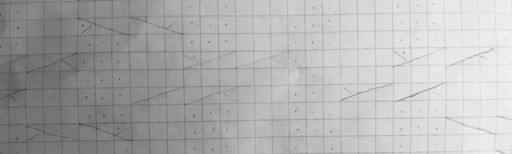
Here is a 4-stitch cable, where two stitches are crossed over two stitches, every 4 rows. The lines in the photo indicate the outside stitch of this Left Cross. See that hole just to the left of the crossing stitches? That’s caused by the crossing. (On a right cross cable, the hole would be on the right of the cable.)
When this cable is worked flat, there is a Right Side Row where you worked the cable cross, followed by a wrong side row, right side row and one more wrong side row. On the next Right Side row you would work a new cable cross.
When you work in-the-round you only have the Right Side facing you. Then you have Round 1 where you cross the cable, followed by Rounds 2, 3 & 4. Then cross again.
If you put something straight into the hole created by the crossing and run it under the horizontal bars to the needle, you should see the 4 bars. I used a sewing up needle but your cable needle may be handy and it would work great.
When you can count 4 bars, you are ready to cross again on the next round. If you have a 6 stitch cable, crossing every 8 rows/rounds, you would work until you can count 8 bars from the hole created by the last crossing. It works.
Designing your own garment? Maybe you are working on the Saddle Up pullover with me and it’s time to work the cables. Here’s what you need to know.
Cables pull your fabric in as soon as the first cable is crossed. You have to make sure you accommodate for this fact or … well, your sweater or project will be much smaller than you had anticipated.
Let’s say you want to work a 4-stitch Rope Cable (worked by crossing 2 stitches over 2 stitches). This cable is worked in stockinette stitch and is a pretty common cable to work.
Once you start crossing this cable, it is no longer the width of 4 stitches. It is closer to the width of 3 stockinette stitches.
If you have a sweater where you want to introduce a 4-stitch Rope Cable, set it up for 3 stockinette stitches to begin with. Then increase 1 stitch before you work the first cross. That’s it.
A basic rule of thumb: for every 3 stitches of the cable, set up 1 less stitch. Add them back in by working increases before the first cross.
Here’s another example: 6-stitch Rope Cable where you will cross 3 stitches over 3 stitches – set up 4 sts and before the first cross, increase 2 stitches (now you have 6 sts for the cable).
This is fairly straightforward, except … (you knew this was coming, right?), the more complex the cable, the harder it is to do this successfully. Do I have to say the S word? Yeah, I do. You have to swatch!
Elizabeth Zimmermann had some great advice. Her suggestion was to cast on 96 stitches and knit a hat with all the cables. It will fit someone.
That can work as your swatch. Measure across the cable once you have worked the cross several times. Use your stockinette stitch gauge to figure out how wide the cable is in stockinette stitches. That is the number of stitches to set up and how many stitches you need to increase before the first crossing.
Example: Let’s say you have a 12 stitch complex cable, repeated several times on your hat, measuring 1.75″ across. Your stockinette gauge is 20 sts = 4″ OR 5 sts = 1″. 1.75″ x 5 sts = 8.75 sts, rounded up to 9 sts. Set Up the cable with 9 stitches and increase 3 stitches in the first row to 12 stitches and cable away.
Norah Gaughan has coined the phrase SSE: Stockinette Stitch Equivalent. The SSE for the complex cable above is 9 sts, even though the chart for the cable is 12 sts wide. Yeah, I know, this can mess with your head.
I would like to recommend her book, Knitted Cable Sourcebook for this information. There are tons of cables in this book and they all have an SSE. She’s done it for you. No swatching necessary. I don’t receive anything if you buy this book. I’m so happy I bought it. You might know that I am not a happy swatcher.
The latest section of the Saddle Up pattern is in your ravelry library. Update the pattern and set up your cables. Have fun.
Do you know how I-cords work? They are a little bit of knitting magic. When paired with Garter Stitch they do all sorts of good things.
First, 2 or 3 stitches of I-Cord on the outside edges of garter stitch give it a tidy finish. This is sometimes called a Built-in I-cord because you work the I-cord edge as you knit the garter stitch fabric.
Secondly, because these outside stitches are slipped every other row, they give the edge stability. They are a tiny bit shorter because they are not worked every row. These I-cord stitches hold the edges firmly so the edge won’t stretch.
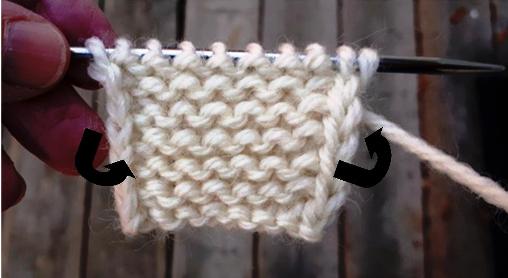
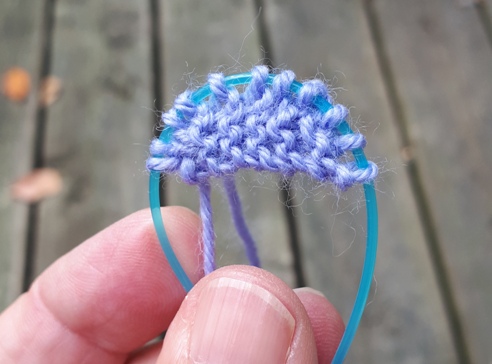
A small sample showing 2-stitch built-in I-cord. It looks the same on both the right side and the wrong side.
Garter Stitch with 2-stitch I-Cord edge: Knit to last 2 sts, bring yarn forward, slip the last 2 sts. This row is worked over and over, on both the right side and wrong side of the fabric.
Left photo: Yarn forward, Slip last 2 sts. Right photo: Turn and bring yarn across back of work, from third stitch to first stitch, and knit first stitch.
When you slip the last 2 sts, your yarn is attached to the 3rd stitch in from the tip of the needle because that was the last stitch you knit. So what happens in the next row? You need to pull the wool across the back of your work, from the third stitch to the first stitch so you can knit the row. This pulls the first stitch around towards the back of your work, as you knit it.
On one edge the second I-cord stitch rolls to the back. On the other edge the second I-cord stitch rolls to the front.
Because these two stitches are slipped every other row they look like stockinette stitch. A 2-stitch I-cord is the tiniest tube you can knit around the edge of your garter stitch fabric.
The Saddle Up pullover begins with a Garter Stitch Saddle with I-cord edges, of course.
The Saddle begins at the left shoulder and is worked across to the the right shoulder, with a hole for your head in the middle. Pretty straight forward, right?
But that’s not all there is to it, of course. That would be way too easy. There is another way of working the 2-stitch I-cord.
There are occasions when you would like both the I-cord stitches to be rolling to the wrong side of your work. This can be done, too. The Saddle uses this technique for the Back of Neck stitches.
On both edges the second I-cord stitch rolls to the wrong side of the fabric.
2-Stitch I-Cord rolling to the wrong side: Right Side Row: Knit to last 2 sts, leave yarn in the back, slip last 2 sts. Wrong Side Row: Purl 2 sts, knit to last 2 sts, yarn forward, slip last 2 sts.
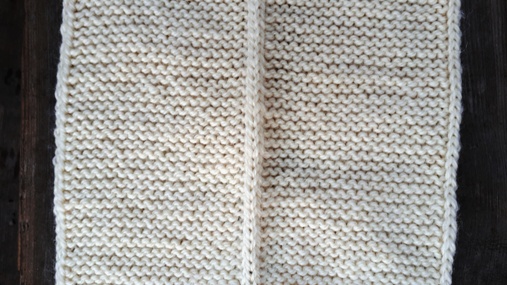
What is that line down the middle of the Saddle? The shoulders of the Saddle for this pullover need a lot of extra stability since the sleeve will be trying to pull it down. So I added some non-stretchy stitches right down the centre. It looks like an I-Cord but it isn’t. The middle 2 stitches are slipped every other row and work the same way, in that these 2 stitches are a tiny bit shorter and won’t stretch. Thanks L for pointing this out.
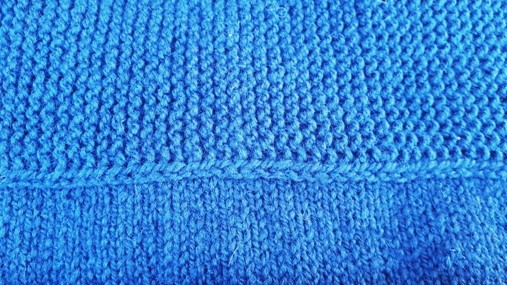
There is one more reason for all this I-Cord business. A 2-stitch I-Cord gives you a sideways stockinette stitch for every garter ridge. In the Saddle Up pullover, stitches are picked up & knit along the bottom edge of the Saddle to form the Front which is worked flat, down to the bottom of the armhole. If you pick up & knit into the I-Cord stitch that has rolled to the back the Saddle, you get a very lovely line of stitches running between the Saddle and the Front. It will never stretch and it’s so very neat and tidy. Don’t you think?
I’ve done the pick up & knit into the I-cord across the bottom edge of the Saddle and have started my cables down the Front.I picked up & knit along the I-cord stitches on bottom edge of the Back of the Saddle and worked stockinette stitch down the Back.
You can add I-cord stitches to any garter stitch project. You may get to love them as much as I do.
Are you are interested in knitting this Saddle Up, drop shoulder pullover with me? I’m publishing each section as I get it done and tested. I’ll update the pattern with each new section as we go along. The Saddle section is up for sale.
I’m interested in any comments, corrections or problems you have with this pattern. I’ve included lots of photos and my blog posts will be featuring this pullover for the next month. Happy to have you join me.
How do you choose cables that go together on a sweater when the choice is yours? It’s not so hard. Here is how I get started. Maybe this will be helpful to you.
I am knitting a Top Down, drop shoulder sweater. Beware, any pattern in a stitch dictionary is meant to be knit bottom up. If knitting Top Down, turn the book upside down when you’re looking at the photos because that’s what they will look like when they are knit. If you do this on the subway you may get some interesting looks.
I chose two different centre patterns that were both 32 rows deep.
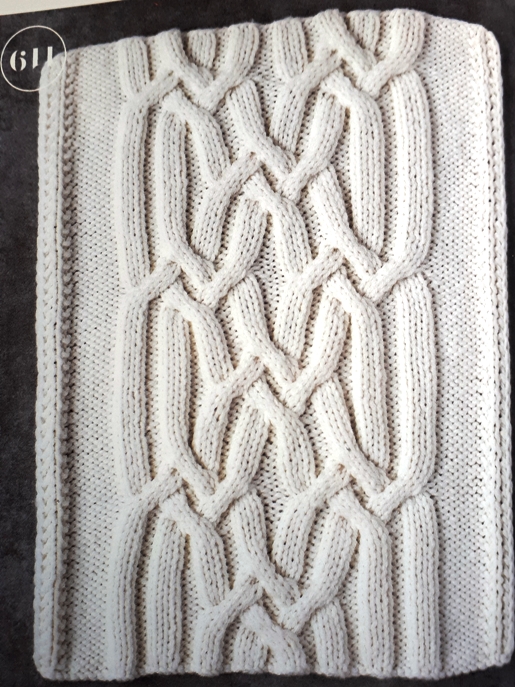
On the left is Tangled Ropes, pg.80 in Charted Knitting Designs, A Third Treasury of Knitting Patterns by Barbara G. Walker. On the right is #119 Crosshatch Bias from Knitted Cable Sourcebook by Norah Gaughan.
Now I chart them. This is swatching with a pencil. Even if they are charted in the stitch dictionary I do it again.
Is it hard to chart?
I love the Tangled Ropes but … I wore out an eraser charting this.
I found it hard to chart and I think it would be a little too complicated to knit for this project.
Look at this one, the Crosshatch Bias. Even though there are many cable crossings, they all cross the same way on each line. It doesn’t get any better than this.
OK, decision made. The centre pattern is settled. I’ve started knitting and it looks complicated even though it’s quite straight forward to knit. Gotta love that.
Then do the same for some side patterns. This time I need them to work with the 32 rows of the centre pattern, meaning that the repeats of the side patterns must add up to 32 rows.
I want one more wide pattern and found a couple I liked. One that was 8 rows deep and a second one that was 16 rows. I’m going with this one.
Then I need a small pattern to take up some space. A 4 stitch cable worked over 4 rows goes into 32 rows quite nicely.
Next, setting them up. Yes, still some work to do before the knitting can start.
Sometimes a project catches you and you just can’t put it down. The V Plus Cardigan has a hold on me. Not just because I need a couple of new cardigans but because I’m back to sweater knitting, my first love. I can’t wait to get this published so you can get started too.
I finished the body of my first prototype. You might catch that the body wool is left over from the Salt & Pepper version of the Family Crew Neck pattern. I added the green stripes in the yoke to make the wool go a little farther since I didn’t have quite enough for a second sweater. (Briggs and Little, Heritage)
I’ve wet blocked the body just to make sure it’s all that it should be. Do you ever block part way through?
Before I embark on the last sprint, the sleeves, I wanted to be sure.
I’m so enamored with this cardigan that I started a second one. (Patons Classic Wool worsted) It’s interfering with the sleeve knitting but it doesn’t take much to do that.
Two, two, two cardigans on the needles. I am welcoming winter. Come and get me, I’ll be ready!
I didn’t block my shawl, I just put it on a really long cable and … it’s definitely too curvy.
So here we go. Rip, rip, rip. Turn away if this is too painful!
While I was merrily ripping away, I decided to take the stripes out too. More ripping but now it’s done.
I thought about the adjustment and here we go again. It’s so difficult to knit with your fingers crossed!
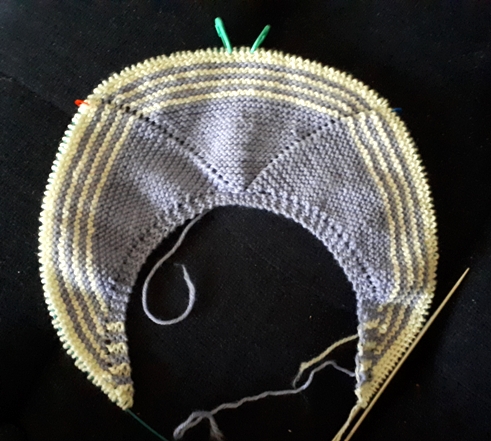
I’m liking the sharp colour change and I’m happy with the curve now. Totally worth the frogging. But … I would like wider wedges. I’d like more texture knitting and a little less garter stitch. So back to ripping again. Let’s see if this yarn can take it. Onward.
I have been thinking about knitted shawls for about a month but had projects to finish first. Knitting a shawl was the carrot in front of my nose, to keep going. Now that they are done I can indulge myself and start a shawl.
I have been teaching knitting for decades and thought I would take one of my shawl workshops and move it a little sideways. I need a challenge and taking something that is working and pushing it in a slightly different direction is fun, as well as frustrating when it doesn’t work out as expected, but that is still fun, believe it or not.
So here I go, a crescent shaped shawl beginning with a garter tab.
This shawl is worked in 2 or 3 parts. The first part is easy to work in garter stitch.
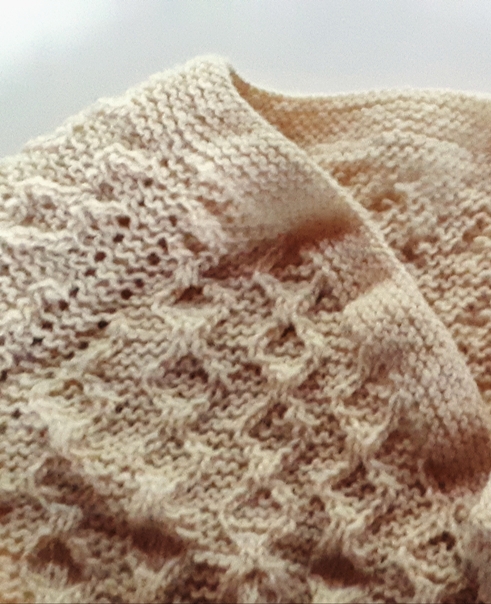
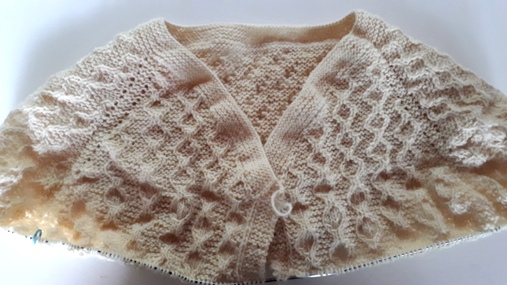
The experimenting starts with the second part of the shawl. I am working different textured patterns. You can’t see them, of course, since the needle is too short to spread it out. You’ll have to take my word for it for now.
I’m not sure about the general shape. My concern at the moment is that it might be too curvy. I need to block it even though it’s only half done. When the needle comes out, all will be revealed. Yikes, this makes me kinda nervous.
I started working on a top down V-neck design earlier in the year. It sort of worked but needed some more thought. It got put aside in favour of the Family Crew Neck pattern.
It’s time to really take a look at this idea again. Summer is perfect for contemplating, don’t you think?
I brought one of my experiments with me and now that time has passed I can look at it with some objectivity (instead of having a little snit and ripping it all out).
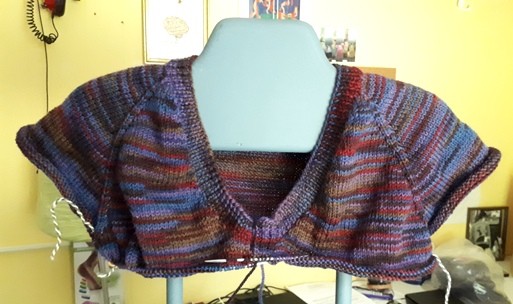
It’s a V-neck cardigan in garter stitch. I’m using a cone of sports/fingering weight wool from https://www.revolutionwoolco.com/
You might notice a tiny ruffle effect in the neckband. Here’s a really good look at it.
Whoops. I was working really, really hard to ignore this. I know that garter stitch has a different row gauge. I know this, really I do. Apparently working garter stitch short rows is a whole different thing. LOL.
I will cut the neckband and redo it, later. Then I will know the trick to getting the correct stitch count for the neckband. I’ll start my next one and everything will go amazingly well!!! Ha, ha, fingers crossed.
Are you having as much knitting fun as I am? Cheers, Deb
The construction for working the Family Crew Neck raglan begins with the neckband. This makes it different from a lot of other Top Down patterns. Once the neckband is knit, short rows are worked to create a neckline where the front is lower than the back.
Because the neckband is worked first it’s important that your cast on is especially stretchy. Quite often the neck opening of a crewneck is smaller than your head circumference. It’s not a great feeling to rip your ears off as you pull your sweater over your head. Especially if you’re working a sweater for a child.
I’ve looked for some videos for stretchy cast ons. Here are the ones I use regularly.
Many stretchy cast ons are based on the long-tail cast on and I found the third one mentioned in this video to be the best (found at 5:10 into the video). Three Wasy to Make A Stretchy Cast On I used it here and since I use the long-tail cast on all the time, I found the third method really easy to work. I think it looks great with K1,P1 ribbing and it is indeed, very stretchy.
Another great cast on is the Crocodile Cast On by Cat Bordhi which is also based on the long-tail cast on. This is my usual cast on. It is stretchy too.
The beauty of starting with the neckband is there is no picking up afterwards. I count this as a big advantage.
Would you rather pick up the neckband? Are you good with starting with a stretchy cast on and going on from there?
I’ve asked a lot of knitters “why don’t you knit sweaters for yourself?” Quite often the answer was that the sleeves don’t fit.
It’s easy enough to work out which size to knit according to your bust measurement but it is another thing to also have the correct sleeve size you need, in the same pattern. So …
My “Any Gauge” sweater patterns have a correction for this common problem: the raglan lines are used as a guide only. They indicate the general placement of the sleeves but do not necessarily give the exact width of the sleeve.
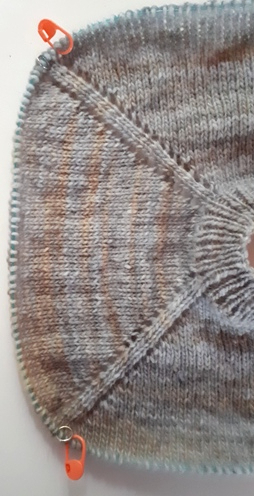
In my latest Family Crew Neck, the sleeve size I want, indicated by the orange markers, is a little wider than the raglan lines.
The pattern is set up to do this. Just before The Great Divide, you place the removable markers (orange) on the circular needle at the exact width you need for your sleeves. They can be inside the raglan lines for a narrower sleeve than the raglan lines indicate, exactly at the raglan lines in the usual way, or outside the raglan lines, like this pullover. The stitches between the orange markers are now the sleeve. Here’s a close-up.
I’m not stealing stitches from the body. The body will still be exactly what I need it to be. The pattern is written in a way to allow for all this variation, to fit both your bust and your arms. It’s working for all the pullovers I’ve knit so far, so I’m quite confident it will also work for you.
One more bit of weird knitting just for you. Enjoy.















 Deb Gemmell: Top Down, Gauge Free and more